
What Is the Pharmaceutical Product Registration Process in Uzbekistan?
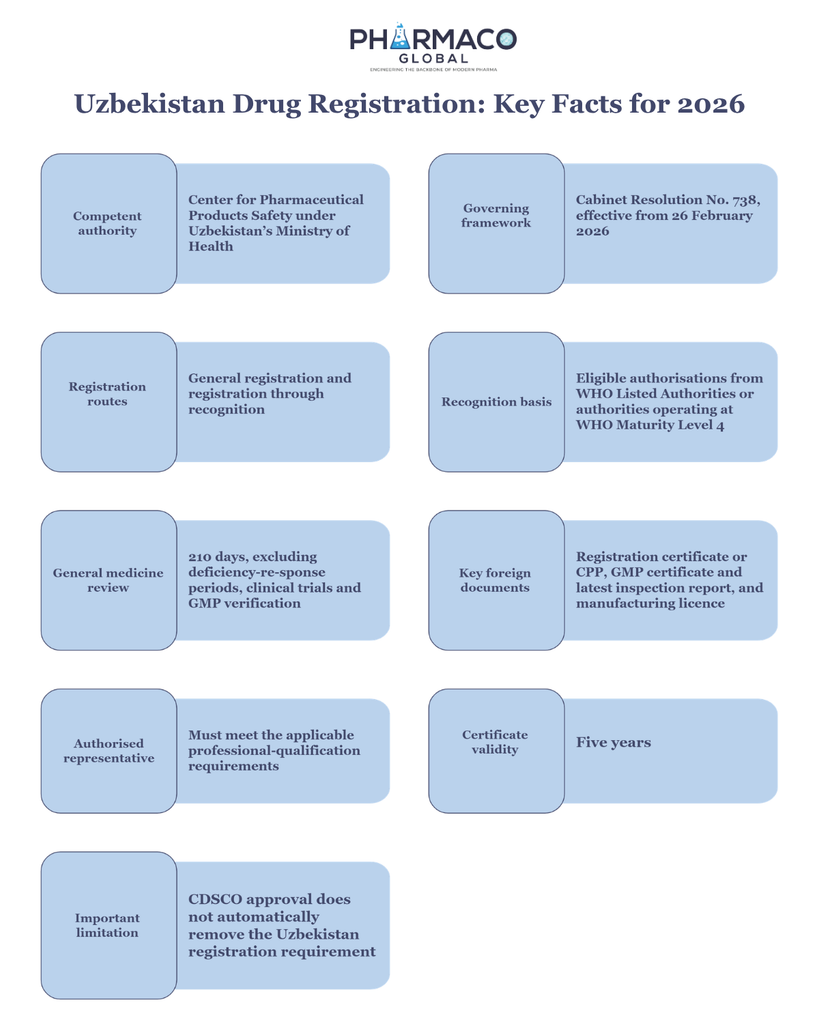
Pharmaceutical products generally require state registration with the Centre for Pharmaceutical Products Safety before commercial supply in Uzbekistan, unless a specific exemption applies. Under Resolution No. 738, medicines may follow the general procedure or an eligible recognition route. The general procedure has a stated 210-day review period, excluding deficiency responses, clinical trials, and GMP verification. CDSCO approval alone should not be assumed to qualify a product for recognition.
The official regulation is published in Uzbek and Russian. The online English rendering is unofficial, so check product-specific decisions against the authoritative text and confirm them with appropriately authorized local specialists.
TL;DR: Pharmaceutical Registration in Uzbekistan
- Medicines intended for commercial supply generally require state registration in Uzbekistan unless a specific exemption applies.
- Resolution No. 738 provides a general procedure and a recognition-based procedure. Recognition is still a state-registration route, not an exemption from registration.
- A CDSCO approval does not by itself establish eligibility for recognition. The foreign authority, authorisation, product and manufacturing site must be assessed against the current rules.
- A published legal analysis reports 210 days for medicines under the general procedure, excluding time for deficiency responses, clinical trials and GMP verification.
- Certain foreign documents must be apostilled or legalised, and the authorised representative must meet the applicable qualification requirements.
- Registration certificates are issued for five years, while safety reporting, registered-product consistency and lifecycle responsibilities continue after approval.
- Stronger India–Uzbekistan cooperation improves the commercial context, but it does not replace product-specific regulatory, quality and investment due diligence.
Pharmaceutical product registration in Uzbekistan has become a more serious board-level question for Indian manufacturers. The country’s revised registration framework took effect in February 2026, while the India–Uzbekistan state visit in August placed pharmaceuticals, local manufacturing and technology transfer higher on the bilateral agenda.
The opportunity, however, is not the same as regulatory readiness. Uzbekistan pharmaceutical market entry still depends on whether the exact product has an appropriate route, defensible evidence, a consistent dossier, a compliant manufacturing site and a supply model that can withstand regulatory review.
For senior management, the decision is therefore not simply whether Uzbekistan is attractive. It is whether the product and operating model remain commercially viable after fully considering registration requirements, evidence risk, execution time, and lifecycle ownership.
What Is the Current Pharmaceutical Product Registration Framework in Uzbekistan?
Uzbekistan’s Cabinet of Ministers adopted Resolution No. 738 on 24 November 2025. It became effective on 26 February 2026 and approved separate regulations for the state registration of medicines and medical equipment.
The competent authority is the Centre for Pharmaceutical Products Safety under the Ministry of Health of the Republic of Uzbekistan. It performs state registration and post-market control functions for medicines and medical devices.
For medicines, the framework provides two broad routes: general registration and registration through recognition.
General registration
- What it means: The product undergoes the applicable national review using the required administrative, quality, safety, efficacy and manufacturing evidence.
- What management must not assume: That a complete submission will automatically result in the shortest possible approval for Uzbekistan drug registration timeline.
Registration through recognition
- What it means: An eligible foreign authorisation may support recognition-based state registration in Uzbekistan. Eligibility depends on the relevant authority, approval, product and site.
- What management must not assume: That recognition is an exemption from registration, or that approval in the country of manufacture is sufficient by itself.
A professional interpretation of Resolution No. 738 identifies regulatory authorities included in the WHO Listed Authorities framework and authorities operating at Maturity Level 4 under the WHO Global Benchmarking Tool as relevant bases for medicine recognition. WHO also notes that WLA status can be limited to particular product categories and regulatory functions. Recognition should therefore be verified for the exact authorisation being relied upon, not inferred from the regulator’s name alone.
What Documents and Representation Are Required for Drug Registration in Uzbekistan?
The complete dossier depends on the product and route. However, the published interpretation of Resolution No. 738 identifies several official foreign documents that must be apostilled or legalised through an Uzbekistan consulate.
- Certificate of registration and/or Certificate of Pharmaceutical Product (CPP) issued in accordance with WHO recommendations
- Certificate of compliance with Good Manufacturing Practice requirements
- Report from the most recent GMP inspection for a foreign manufacturer
- Licence authorising the manufacture of the medicine
The authorised representative must hold a higher-education qualification in pharmacy, medicine, chemistry or biology. An application-review fee also applies and is non-refundable if the applicant withdraws the application or the registration is refused.
These points do not constitute the complete product dossier. Administrative forms, quality documentation, safety and efficacy evidence, samples, product information, labeling, and other material may be required depending on the product and route. Confirm the exact submission package against the current official-language regulation before filing.
Why Must the Dossier and Commercial Product Match?
The product name, formulation, dosage form, strength, indication, manufacturer, manufacturing site and commercial pack should remain consistent across the application and supporting evidence. A change that appears minor to sales or supply teams may affect the filed regulatory position.
This alignment is especially important when a distributor forecasts one configuration while regulatory affairs prepares another. Freeze the commercial SKU before the filing strategy is approved.
What Are the Steps for Drug Registration in Uzbekistan?
The exact sequence depends on the product and route, but registration planning generally involves the following stages:
- Confirm the product category. Establish whether the product is a medicine, medical device, traditional medicine, supplement, cosmetic or another regulated category.
- Determine the registration route. Assess whether the general procedure or recognition route applies to the specific product and foreign authorization.
- Confirm the applicant and representative. Establish who will hold the registration and whether the authorised representative meets Uzbekistan’s current requirements.
- Prepare and legalise the documentation. Align the dossier, CPP or registration certificate, GMP evidence, manufacturing licence, product information and any required samples.
- Complete the applicable examination. The submission may undergo initial review, specialised examination, laboratory assessment, clinical-data review and GMP verification.
- Respond to deficiencies. Authority questions and remediation periods sit outside the stated review timeline and must be included in launch planning.
- Maintain the registration. Following approval, the certificate holder must manage safety reporting, registered-product consistency, changes, supply commitments and renewal requirements.
This is a planning overview, not a substitute for product-specific interpretation of the official Uzbek- or Russian-language regulation.
Are CDSCO-Approved Medicines Automatically Recognised in Uzbekistan?
No. A CDSCO approval should not be treated as an automatic right to use Uzbekistan’s recognition procedure. Eligibility must be established against Uzbekistan’s current requirements and the specific foreign authorisation being presented.
WHO Listed Authority designations and maturity classifications are also scope-specific. A regulator may have a recognised status for a particular product category or regulatory function without that status applying to every medicine or decision it has authorised.
That makes “approved in India” the beginning of the assessment, not the conclusion. Management should confirm:
- The foreign regulator and exact authorisation being relied upon
- The product category covered by the regulator’s recognised status
- The medicine, dosage form, strength, indication and commercial presentation
- The manufacturing site and GMP evidence linked to the authorisation
- Any Uzbekistan-specific documents, examination or registration steps that remain applicable
How Long Does Medicine Registration in Uzbekistan Take?
A published legal analysis of Resolution No. 738 reports the following review periods.
- Vaccines: 30 days
- Medicinal substances: 45 days
- Medicines under the general procedure: 210 days
These periods exclude time allocated to correct deficiencies identified during initial and specialised examination. They also exclude any required clinical trials and the time spent verifying GMP compliance.
A 210-day review period should therefore not be presented internally as a 210-day route to revenue. The decision-grade plan should include three separate clocks:
- Pre-submission readiness: Time needed to close dossier, evidence, manufacturing-site, translation and legalisation gaps
- Regulatory review: The applicable authority period, including likely questions, testing and inspection dependencies
- Post-authorisation launch: Packaging release, import, distribution, safety ownership and market activation
If the business case works only under the shortest interpretation of the regulatory clock, it is not yet sufficiently robust for approval.
How Long Is a Drug Registration Certificate Valid in Uzbekistan?
The published interpretation of Resolution No. 738 states that a medicine registration certificate is issued for five years. Renewal planning should begin early enough to confirm the current renewal procedure, evidence requirements, registered details and any changes made since approval.
What Responsibilities Continue After Registration?
Approval does not end the applicant’s responsibilities. The published legal analysis states that the applicant must maintain the accuracy of the registration file, protect the medicine’s quality, safety and efficacy, and regularly submit information on adverse effects. It also requires placing the registered medicine on the Uzbekistan market for at least three years, except for medicines produced by domestic manufacturers for export.
How Much Does Drug Registration in Uzbekistan Cost?
The framework provides for an application-review fee, but you should not assume a single reliable budget for every product. Total cost can vary by route, product type, dossier remediation, translation, legalization, samples, testing, clinical-data requirements, GMP verification, and local representation. Confirm the current official fee schedule and all additional execution costs before the entry case is approved.
Why Does Efficacy Evidence Deserve Board-Level Attention?
Medicine registration is not simply an administrative exercise. Order No. 3806, registered on 3 April 2026, establishes a framework for identifying medicines whose efficacy has been studied but not substantiated and medicines whose efficacy has not been adequately studied. The order states that it enters into force three months after official publication.
For management, this moves evidence review earlier in the investment decision. A molecule may have attractive demand, an established domestic history, and a complete technical file, yet still carry registration risk if the intended indication or claim does not align with the evidence expected during specialized examination.
Three questions should be answered before dossier adaptation begins:
- Does the evidence support the exact indication and claims proposed for Uzbekistan?
- Are the pivotal data, systematic reviews or other scientific sources consistent with the intended product position?
- Could an evidence limitation alter the label, commercial forecast or portfolio priority?
This is not a wording issue for regulatory affairs to solve at the end. It is a portfolio issue because an inadequate evidence position can change the product’s commercial value.
Do Medicines and Medical Devices Follow the Same Registration Process?
No. Resolution No. 738 provides separate regulations for medicines and medical devices. Medical devices are classified as Classes I, IIa, IIb and III according to risk. The published legal analysis reports general-procedure review periods of 60 working days for Class I, 90 working days for Class IIa, and 120 working days for Classes IIb and III, excluding specified deficiency, clinical-trial and conformity-assessment periods.
Device route selection also depends on intended use, model, configuration, software version, sterilisation method, quality evidence, labelling and the foreign approval being relied upon. Companies planning a device launch should use a dedicated product-specific assessment rather than applying the medicine-registration pathway.
Decision Trigger: If the final Uzbekistan product configuration is not frozen, the registration strategy is not ready for approval.
Why Has Uzbekistan Become a Bigger Pharmaceutical Opportunity in 2026?
The India–Uzbekistan joint statement of 30 August 2026 elevated bilateral relations to a Comprehensive Strategic Partnership and identified pharmaceuticals as an area with further trade and investment potential. It highlighted Tashkent Pharma Park as a platform for joint projects, modern manufacturing, localisation and technology transfer.
The two governments also agreed to promote regulator dialogue and explore mutual-recognition arrangements. They did not announce an operative arrangement granting Indian medicines automatic access.
This makes Uzbekistan a market worth reassessing, but not a reason to approve a dossier, appoint a distributor or commit facility capital without product-specific due diligence.
Management Takeaway: Bilateral momentum strengthens the commercial case. It does not replace registration, evidence, quality or manufacturing readiness.
Which Products Should Indian Manufacturers Prioritise for Uzbekistan?
Not every technically registrable product deserves registration. Evaluate regulatory feasibility and commercial value in the same decision.
Product–market fit
- Proceed when: Demand, pricing, competition and channel access support a credible revenue case.
- Hold when: The opportunity depends mainly on broad market-growth assumptions.
Route confidence
- Proceed when: You have verified the classification and likely registration route for the exact product.
- Hold when: Recognition is assumed because the product has an Indian or other foreign approval.
Evidence strength
- Proceed when: Indications, claims and supporting evidence can withstand specialised review.
- Hold when: Commercial positioning is broader than the available evidence.
Dossier integrity
- Proceed when: Product, site, formulation, specifications and pack data are consistent and current.
- Hold when: Critical documents are expired, contradictory or tied to another configuration.
Supply readiness
- Proceed when: Manufacturing, artwork, import, storage and distribution can support the registered product.
- Hold when: The proposed SKU, site or pack is likely to change during review.
Ownership
- Proceed when: Applicant, authority-response, quality, safety and lifecycle responsibilities have named owners.
- Hold when: Responsibilities sit loosely with a distributor or commercial agreement.
Economics
- Proceed when: The business case absorbs realistic regulatory and launch contingencies.
- Hold when: Returns depend on the fastest theoretical approval date or immediate scale.
The portfolio question is therefore: Which product retains commercial value after regulatory risk, execution time and lifecycle ownership are priced in?
Export, Technology Transfer or Local Manufacturing: Which Entry Model Fits?
Tashkent Pharma Park gives local production and joint projects greater strategic visibility. However, localisation is not automatically more attractive than export. Each model creates a different balance of capital, control, regulatory responsibility and execution exposure.
- Finished-product export
- Strategic advantage: Lower initial facility commitment and a controlled way to test the market
- Primary exposure: Registration, dossier localisation, packaging, import, storage and distributor performance
- Best fit when: Demand should be validated before major capital is committed
- Technology transfer or joint manufacturing
- Strategic advantage: Local capability, partner access and potential long-term cost or supply benefits
- Primary exposure: Knowledge transfer, analytical-method transfer, equipment equivalence, validation and divided quality ownership
- Best fit when: The partner, volume case and governance model are credible
- Local manufacturing investment
- Strategic advantage: Greater long-term control and strategic presence
- Primary exposure: CAPEX, facility design, utilities, equipment, commissioning, qualification, validation and operational ramp-up
- Best fit when: Portfolio scale and market durability justify an infrastructure programme
The best model is the one that aligns expected volume, margin, control, regulatory risk and capital exposure rather than the one with the strongest policy narrative.
When Should Engineering Enter the Market-Entry Discussion?
Engineering should enter immediately when localisation or technology transfer is a serious option.
Once local manufacturing becomes part of the strategy, registration and project execution become interdependent. Product mix affects capacity. Process requirements shape the facility. Equipment and utilities affect technology transfer. Cleanroom zoning, HVAC, material and personnel flows, commissioning and qualification determine whether the proposed site can support the regulatory case.
Testing these assumptions before a commercial agreement or CAPEX approval allows management to compare the real investment case before layout, equipment and validation decisions become difficult to reverse.
What Commonly Weakens an Uzbekistan Market-Entry Case?
Most high-cost problems do not begin with an authority refusal. They begin with an assumption that remains untested for too long.
The Portfolio Is Chosen Only on Sales Potential
High forecast demand cannot compensate for weak route eligibility, incomplete evidence or an unstable manufacturing configuration. Regulatory feasibility should form part of product selection rather than being checked after the portfolio is announced.
Foreign Approval Is Treated as Portable
A foreign approval may support the case, but it does not automatically determine the Uzbekistan route. The approval, regulator, product, manufacturing site and recognised scope must meet the relevant conditions.
The Dossier and Commercial SKU Drift Apart
Changes to the pack, site, specification, model, software or intended use can create inconsistencies between the filed product and the product the business intends to sell.
Local Accountability Is Left With “The Partner”
Authority communication, deficiency responses, complaints, safety reporting, registration maintenance and change control require named responsibilities. A distributor relationship is not a substitute for regulatory governance.
Local Manufacturing Is Approved Before Feasibility Is Mature
If capacity, process flow, clean utilities, equipment, HVAC, qualification and validation are considered only after the investment headline is agreed, the programme begins with avoidable uncertainty.
These weaknesses affect launch timing, cash flow, partner confidence and the credibility of the investment case, not just the regulatory submission.
Is Your Uzbekistan Entry Case Ready for Executive Approval?
Before authorising registration spend or localisation CAPEX, management should be able to answer these questions clearly:
- Which exact product and commercial configuration are being proposed?
- What is the confirmed regulatory category and likely registration route?
- Which evidence, dossier or manufacturing gaps could change the forecast?
- Who owns the applicant, authority-response, quality, safety and lifecycle responsibilities?
- Does the supply model support the same product, site and pack described in the dossier?
- Is the entry model export, technology transfer or local manufacturing, and has its full risk been costed?
- Does the business case remain attractive under a realistic Uzbekistan drug registration timeline rather than the best-case timeline?
If two or more answers remain provisional, a focused readiness phase may be more valuable than immediately authorising a filing. Resolving those uncertainties can protect a much larger regulatory, commercial or engineering commitment.
Pharmaco Global: Integrated Regulatory and Engineering Support for Uzbekistan Pharmaceutical Market Entry
Uzbekistan pharmaceutical market-entry programmes can lose time and capital when regulatory planning and facility engineering progress separately. Pharmaco Global brings in-house GMP regulatory expertise and pharmaceutical facility engineering under one accountable structure, aligning the site, quality documentation and commercial strategy from the outset.
This integrated approach helps leadership determine whether the proposed facility can support the intended products and whether its design, quality systems and documentation are being developed with inspection readiness in mind. Pharmaco Global has active projects across 15+ countries and experience delivering pharmaceutical facilities in Uzbekistan.
Regulatory and GMP Readiness for Drug Registration in Uzbekistan
Pharmaco Global’s in-house regulatory team provides regulatory gap analysis and submission documentation, reviewing the product, facility, quality systems and supporting evidence against the applicable target requirements. Support may include:
- GMP gap analysis against the target standard, supported by a prioritised remediation plan
- Preparation and review of product dossiers, Site Master Files, QMS documentation and SOPs
- Preparation and review of validation protocols and reports
- Mock GMP audits, CAPA planning and inspection-readiness training
- Support with regulator queries, inspection observations and audit responses
Identifying these gaps early helps reduce avoidable redesign, documentation rework and delays later in the programme.
GMP Facility Engineering for Technology Transfer and Local Manufacturing in Uzbekistan
When the market-entry strategy involves technology transfer or local manufacturing, Pharmaco Global’s GMP facility design and engineering team plans the facility around the intended product portfolio, capacity requirements and target GMP standard.
Its services cover conceptual, basic and detailed design and are structured across 102 documented engineering deliverables, including:
- Feasibility assessment, facility zoning and capacity planning
- Process engineering and utility planning
- Cleanroom zoning, HVAC design and pressure-cascade planning
- Clean utility design for Purified Water, WFI and Pure Steam
- Production equipment selection and integration
- Commissioning and qualification documentation
GMP audits and risk assessments are incorporated into the design process. This allows cleanroom classifications, material and personnel flows, HVAC zoning and contamination-control requirements to be addressed before the facility layout is finalised.
One Accountable Structure From Concept to Commissioning
For larger localisation programmes, Pharmaco Global’s pharmaceutical turnkey project model brings regulatory, engineering and execution activities under a single point of accountability.
This structure helps reduce coordination gaps among architects, HVAC engineers, equipment suppliers and regulatory specialists. It also provides one contract and one escalation route from feasibility and design through commissioning, qualification and inspection readiness.
Organisations still determining the appropriate compliance framework can also review Pharmaco Global’s guide to EU GMP, WHO GMP and USFDA cGMP.
Pharmaco Global supports regulatory readiness, documentation, engineering and project execution. Product-registration decisions, eligibility for recognition pathways and the issuance of certificates remain the responsibility of Uzbekistan’s competent authorities. Formal local representation and product-specific regulatory interpretation may also require appropriately authorised in-country specialists.
Build a Decision-Ready Uzbekistan Pharmaceutical Market-Entry Plan
Before committing capital, leadership needs clarity on the regulatory pathway, product evidence, supply model and localisation requirements. Pharmaco Global combines regulatory, GMP and engineering expertise to identify critical gaps, establish priorities and turn your Uzbekistan opportunity into an executable market-entry roadmap.
Assess Your Uzbekistan Entry Plan Today.
Frequently Asked Questions About Drug Registration in Uzbekistan
Do Indian Medicines Need Registration in Uzbekistan?
Yes, medicines intended for commercial supply generally require state registration unless a specific exemption applies. Stronger bilateral cooperation between India and Uzbekistan has not removed product-specific registration requirements.
Are CDSCO-Approved Products Automatically Recognised in Uzbekistan?
No automatic recognition should be assumed. Eligibility depends on Uzbekistan’s current rules, the foreign regulatory authority, recognised scope, exact product, authorisation, manufacturing site and supporting documents.
What Documents Are Required for Drug Registration in Uzbekistan?
Requirements vary by product and route. Published analysis identifies the foreign registration certificate or CPP, GMP certificate, latest inspection report and manufacturing licence among the official documents that require apostille or consular legalisation. A complete product-specific dossier and other supporting material may also be required.
How Long Does Drug Registration in Uzbekistan Take?
A published legal analysis reports 210 days for medicines under the general procedure. This excludes periods for correcting deficiencies, any required clinical trials and GMP verification. Pre-submission preparation and post-authorisation launch activities must also be added to the plan.
How Long Is a Medicine Registration Certificate Valid?
The published interpretation of Resolution No. 738 states that a medicine registration certificate is issued for five years. Renewal requirements should be verified against the rules and guidance in force before the certificate expires.
Does Local Manufacturing Remove the Need for Product Registration?
Local manufacturing should not be treated as an automatic substitute for product registration or site compliance. The product, manufacturing facility, quality system, technology-transfer scope and market pathway must be assessed together.
When Should Technology-Transfer Planning Begin?
Technology-transfer planning should begin during market-entry feasibility and before binding CAPEX or production commitments. Process requirements, analytical methods, equipment, utilities, training, qualification, validation and quality ownership can materially change project cost and timing.