
HVAC systems
Pharmaco Global designs and commissions pharmaceutical HVAC systems engineered to maintain controlled environmental conditions in GMP-regulated facilities – including sterile manufacturing areas, biotechnology suites, cleanrooms, and quality control laboratories.
In regulated pharmaceutical environments, HVAC is a critical process utility -not a comfort system. It directly governs product quality, operator safety, and audit readiness by controlling temperature, humidity, pressure differentials, and airborne particulate levels in compliance with WHO GMP, USFDA, EU GMP, and ISO 14644 cleanroom standards.
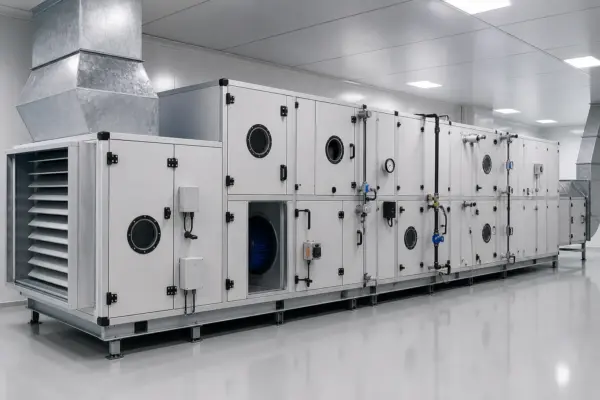
Each system integrates HEPA filtration, air handling units, and automated environmental controls to deliver consistent, validated airflow across cleanroom classifications and pressure cascade zones. Pharmaco Global executes full IQ/OQ/PQ validation, ensuring every system is commission-ready and compliant from day one.
Designed for scalability and energy efficiency, these systems support reliable long-term operations across production and QC areas – and are built to withstand regulatory audits without remediation
Frequently Asked Questions
In GMP pharmaceutical manufacturing, HVAC is a critical process utility — not a comfort system. It controls airborne particulate levels, temperature, humidity, and room-to-room pressure differentials to protect product quality, prevent cross-contamination, and maintain cleanroom classifications as required by WHO GMP, EU GMP Annex 1, USFDA, and ISO 14644 standards.
GMP cleanroom air change rates depend on classification: Grade D (ISO 8) requires a minimum of 20 ACH; Grade C (ISO 7) typically 40–60 ACH; Grade B (ISO 6) 150–300 ACH; Grade A (ISO 5) unidirectional airflow at 0.36–0.54 m/s. Actual ACH is determined by risk assessment, heat load, and process contamination requirements per EU GMP Annex 1.
A cleanroom pressure cascade maintains positive pressure differentials of 5–15 Pa between adjacent zones of decreasing cleanliness, ensuring airflow always moves from cleaner to less-clean areas. This prevents cross-contamination of product, personnel, and APIs across cleanroom grades and is a mandatory GMP requirement under EU GMP Annex 1, WHO GMP, and ISO 14644-4.
Pharmaceutical HVAC systems require terminal HEPA filtration at 99.97% efficiency (H14 grade, EN 1822) for Grade C and D areas, and 99.99% efficiency for Grade A and B areas. HEPA filters are installed at air handling units or terminal diffusers and must be integrity-tested (DOP/PAO challenge) during IQ/OQ validation and at defined re-certification intervals.
GMP pharmaceutical cleanrooms typically require temperature control at 20–22°C for Grade A/B sterile manufacturing areas and 18–26°C for Grade C/D support areas, with relative humidity maintained at 30–50% RH to prevent microbial growth and static charge. Exact setpoints are product and process-specific and must be validated and monitored continuously with SCADA-linked environmental monitoring systems.
Pharmaceutical HVAC validation confirms that systems are installed correctly (IQ — Installation Qualification), operate within defined parameters (OQ — Operational Qualification), and consistently maintain cleanroom classification under simulated production conditions (PQ — Performance Qualification). Validation includes airflow velocity, air change rate, pressure differential, temperature, humidity, particle count, and HEPA filter integrity testing, all documented to GMP standards.
Recirculating HVAC systems return a portion of conditioned air through HEPA filtration, improving energy efficiency — suitable for most OSD and support areas. 100% fresh air (once-through) systems exhaust all supply air without recirculation, required for highly potent API handling, oncology suites, and containment areas where recirculation poses a cross-contamination or operator exposure risk.
Common HVAC-related GMP audit failures include inadequate or unvalidated pressure differentials between cleanroom zones, insufficient air change rates for the assigned classification, HEPA filter integrity failures, missing or expired HVAC qualification records, and unmonitored environmental excursions. These failures occur when HVAC is treated as a building system rather than a validated, continuously monitored GMP process utility.
Talk to Our Engineering Experts
Share your requirements and our team will get back with tailored solutions.
Talk to Our Engineering Experts
Share your requirements and our team will get back with tailored solutions.