
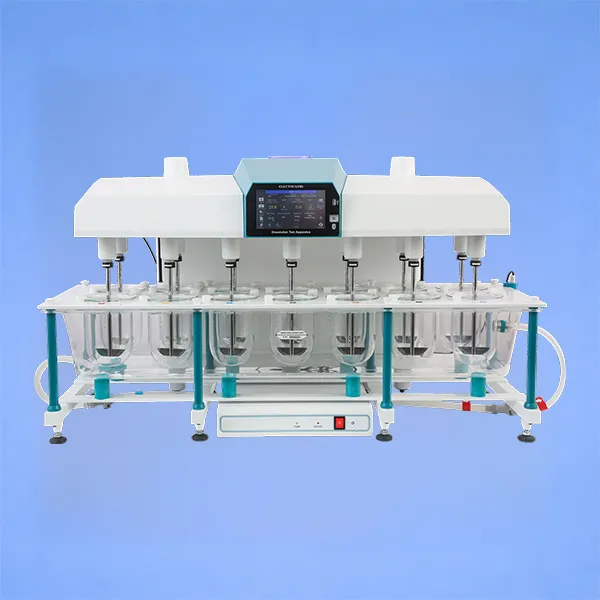
Dissolution Tester
A dissolution tester for pharmaceutical applications is a laboratory instrument used to measure the rate at which an active pharmaceutical ingredient is released from a solid dosage form, such as a tablet or capsule, under controlled conditions. By simulating in-vivo release in a liquid medium, it provides a reliable and reproducible method to assess product performance and batch consistency.
Dissolution testing is central to pharmaceutical quality control, supporting formulation development, in-process verification, and stability studies. It enables accurate comparison of release profiles, ensures each batch meets required specifications, and helps maintain consistent product performance throughout its shelf life in GMP-regulated environments.
Key Features
- Precise control of temperature and agitation parameters
- Consistent and repeatable drug release testing
- Supports tablets, capsules, and solid dosage forms
- Suitable for QC, formulation, and stability studies
- Designed for pharmacopeial compliance (USP, IP, EP)
Frequently Asked Questions
A dissolution tester measures the rate and extent at which an active pharmaceutical ingredient (API) dissolves from a solid dosage form—tablets, capsules, or patches—in a controlled dissolution medium. It predicts in vivo drug release behaviour, ensuring bioavailability, batch-to-batch consistency, and regulatory compliance for oral solid dosage forms.
USP Chapter <711> defines multiple dissolution apparatus types: Apparatus 1 (rotating basket) for capsules and tablets, Apparatus 2 (paddle) for tablets and suspensions, Apparatus 3 (reciprocating cylinder) for extended-release, Apparatus 4 (flow-through cell) for poorly soluble drugs, and Apparatus 5–7 for transdermal and specialised dosage forms.
USP Apparatus 1 uses a rotating wire mesh basket to hold the dosage form, preventing floating—ideal for capsules and coated tablets. Apparatus 2 uses a rotating paddle, allowing the dosage form to sink freely to the vessel bottom. Paddle apparatus is the most widely used for conventional immediate-release tablet dissolution testing.
Standard dissolution testing uses pH-adjusted buffers (pH 1.2 simulating gastric, pH 4.5 and 6.8 simulating intestinal fluids), water, or simulated biological fluids at 37 ± 0.5°C to mimic physiological conditions. Media volume is typically 500–1,000 mL per vessel, as specified in USP, EP, and JP pharmacopoeial monographs for each drug product.
Yes. GMP-compliant dissolution testers meet USP <711>, European Pharmacopoeia 2.9.3, and JP 6.10 requirements. They include validated temperature control (37 ± 0.5°C), calibrated spindle speed, vessel geometry per pharmacopoeial specification, and full IQ/OQ/PQ qualification documentation to satisfy FDA, EMA, and global regulatory agency inspection requirements.
Dissolution testers generate in vitro drug release profiles that, when correlated with in vivo pharmacokinetic data, establish IVIVC—allowing dissolution testing to predict bioavailability. A validated IVIVC enables regulatory agencies to accept in vitro dissolution data as a surrogate for costly clinical bioequivalence studies during post-approval formulation changes.
Yes. Dissolution testers equipped with USP Apparatus 3 (reciprocating cylinder) or Apparatus 4 (flow-through cell) are specifically designed for extended-release, controlled-release, and modified-release formulations. These apparatus types provide variable pH and flow conditions across the dissolution run, mimicking the changing gastrointestinal environment over multi-hour drug release profiles.
Dissolution testers must undergo IQ/OQ/PQ qualification at installation and routine calibration per USP <711> and regulatory GMP requirements. This includes verification of vessel temperature (37 ± 0.5°C), spindle speed accuracy, vessel dimensions, and wobble. Annual re-qualification and mechanical calibration checks at defined intervals maintain GMP compliance and data integrity.
Yes, all our products are designed and sourced to meet international regulatory standards, including GMP, USFDA, EU-GMP, WHO, and other relevant compliance requirements.
Absolutely. Our solutions are engineered for seamless integration with existing systems, ensuring minimal disruption and optimal performance within your current setup.
Yes, our team offers technical consultation to help you choose the most suitable product based on your process requirements, facility design, and compliance needs.
Yes, all our products are aligned with our turnkey execution approach, ensuring compatibility with overall facility design, engineering, and operational requirements.
Yes, we provide customised solutions tailored to your process, capacity, and regulatory requirements to ensure optimal performance and efficiency.
Our products are used across pharmaceutical manufacturing, biotechnology, nutraceuticals, research laboratories, and regulated healthcare environments.
We follow strict quality standards and work with trusted technologies and manufacturing processes to ensure consistent performance, durability, and compliance.
Yes, we offer ongoing technical support to ensure smooth operation, performance optimisation, and long-term reliability of all supplied systems and components.