
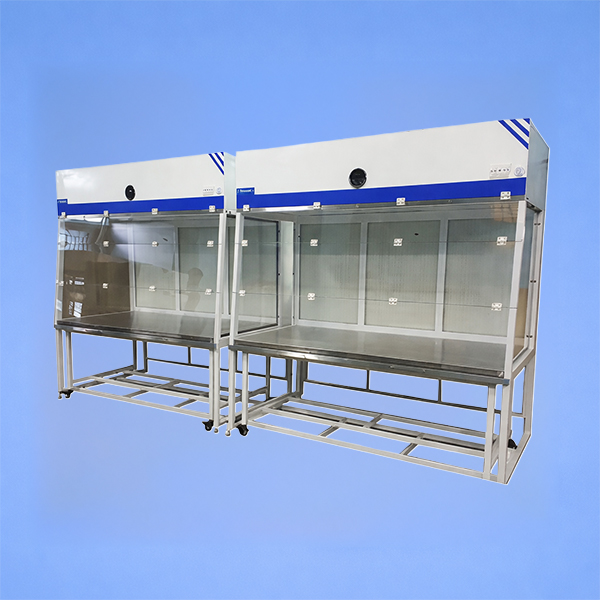
Laminar Airflow
A laminar airflow system for pharmaceutical applications delivers filtered air in a uniform, unidirectional flow to maintain a clean work zone and prevent airborne contamination during laboratory and production operations.
These units are used in pharmaceutical manufacturing and research environments to ensure consistent particle control and support GMP-compliant processes.
Key Features
- Unidirectional, HEPA-filtered airflow
- Maintains contamination-free work zone
- Prevents particle deposition on products
- Suitable for lab and production use
- Supports GMP-compliant environments
Related products
Frequently Asked Questions
A laminar airflow (LAF) unit delivers unidirectional HEPA-filtered air across a work surface, creating an ISO Class 5 particle-free environment. Used in pharmaceutical manufacturing for aseptic dispensing, sterile product preparation, and quality control testing, LAF units protect open drug products and components from airborne microbial and particulate contamination.
Vertical laminar airflow units deliver HEPA-filtered air from the ceiling downward, sweeping particles away from the product below—ideal for aseptic filling and open vial work. Horizontal units blow air from the rear wall toward the operator, protecting the work surface. Vertical flow is preferred in pharmaceutical aseptic processing for superior product protection.
A properly validated laminar airflow unit achieves ISO Class 5 (equivalent to EU GMP Grade A), the highest cleanliness classification for pharmaceutical manufacturing. This means a maximum of 3,520 particles per cubic metre at ≥0.5 µm, meeting FDA aseptic processing guidelines and EU GMP Annex 1 requirements for critical zone protection.
Pharmaceutical laminar airflow units must use H14-grade HEPA filters with ≥99.995% efficiency for particles ≥0.3 microns, tested to EN 1822. Filters undergo in-situ integrity testing using DOP/PAO aerosol challenge after installation and at regular intervals—typically every 6–12 months—to confirm no leakage and sustained ISO Class 5 performance.
Yes. EU GMP Annex 1 (2022) explicitly requires laminar airflow systems to protect critical zones (Grade A) during all aseptic operations, including filling, stoppering, and open container exposure. Unidirectional airflow at a velocity of 0.36–0.54 m/s must be demonstrated to sweep particles away from exposed product and components.
Laminar airflow creates a continuous unidirectional curtain of HEPA-filtered air at the critical zone, physically displacing airborne particles and microorganisms away from open drug products and components. This prevents settlement contamination and turbulent particle ingress, maintaining the ISO Class 5 conditions required for aseptic pharmaceutical manufacturing and compounding.
EU GMP Annex 1 and FDA aseptic processing guidelines recommend a unidirectional airflow velocity of 0.36–0.54 m/s (approximately 72–108 ft/min) at the working surface. This velocity provides effective particle sweep-away without creating turbulence that could introduce contamination. Velocity uniformity across the work surface must be verified during qualification.
HEPA filter integrity in pharmaceutical LAF units should be tested at installation, after any filter change or maintenance, and at least every 6–12 months during routine operation. Testing uses DOP or PAO aerosol challenge per ISO 14644-3 and EN 1822, confirming filter integrity and sustained ISO Class 5 performance at critical zones.
Yes, all our products are designed and sourced to meet international regulatory standards, including GMP, USFDA, EU-GMP, WHO, and other relevant compliance requirements.
Absolutely. Our solutions are engineered for seamless integration with existing systems, ensuring minimal disruption and optimal performance within your current setup.
Yes, our team offers technical consultation to help you choose the most suitable product based on your process requirements, facility design, and compliance needs.
Yes, all our products are aligned with our turnkey execution approach, ensuring compatibility with overall facility design, engineering, and operational requirements.
Yes, we provide customised solutions tailored to your process, capacity, and regulatory requirements to ensure optimal performance and efficiency.
Our products are used across pharmaceutical manufacturing, biotechnology, nutraceuticals, research laboratories, and regulated healthcare environments.
We follow strict quality standards and work with trusted technologies and manufacturing processes to ensure consistent performance, durability, and compliance.
Yes, we offer ongoing technical support to ensure smooth operation, performance optimisation, and long-term reliability of all supplied systems and components.