
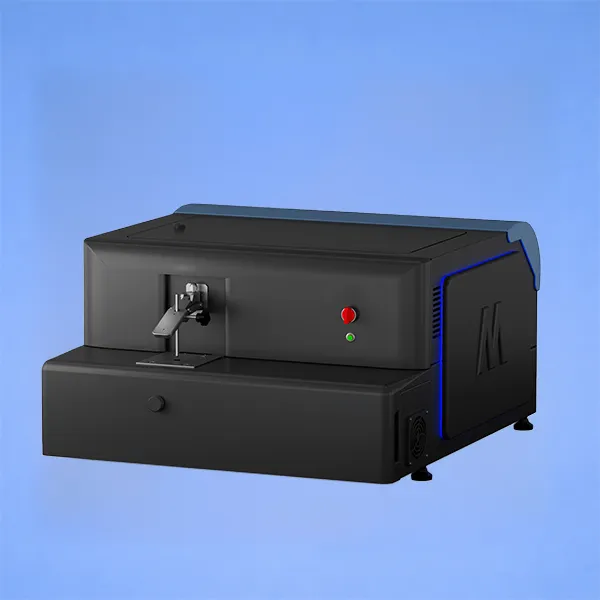
Optical Emission Spectrometer
An optical emission spectrometer for elemental analysis is an analytical instrument used to identify and quantify the elemental composition of metal samples by measuring the light emitted when the material is excited by an electrical discharge. Each element emits light at characteristic wavelengths, allowing accurate determination of composition and concentration.
This method of atomic emission analysis is widely used in manufacturing, quality control, and research environments for fast and reliable metal testing. It enables simultaneous analysis of multiple elements and works directly on solid samples with minimal preparation, ensuring consistent and precise results in demanding applications.
Key Features
- Accurate elemental composition analysis
- Simultaneous multi-element detection
- Fast and reliable testing results
- Minimal sample preparation required
- Suitable for QC, manufacturing, and research applications
Frequently Asked Questions
An optical emission spectrometer (OES), typically ICP-OES, uses a high-temperature inductively coupled plasma to excite atoms in a dissolved sample, causing them to emit light at element-specific wavelengths. A detector measures emission intensities to identify and quantify elemental concentrations—making it essential for pharmaceutical elemental impurity testing.
ICP-OES is used in pharmaceutical QC for elemental impurity testing of raw materials, APIs, excipients, drug products, and container closure systems. It simultaneously quantifies up to 70 elements in a single run, ensuring compliance with ICH Q3D, USP <232>, USP <233>, and EU pharmacopoeial elemental impurity limits.
ICH Q3D (Elemental Impurities) mandates control of 24 elemental impurities in pharmaceutical products, with permitted daily exposure (PDE) limits defined. USP <232> sets elemental impurity specifications and USP <233> specifies ICP-OES and ICP-MS as the recommended procedures for accurate, sensitive elemental impurity quantification in drug substances and drug products.
ICP-OES simultaneously detects and quantifies up to 70 elements including ICH Q3D Class 1 (arsenic, cadmium, lead, mercury), Class 2A/2B (cobalt, nickel, vanadium, silver), and Class 3 (barium, copper, zinc, manganese) elemental impurities. Detection limits typically reach 0.01–1 µg/L in solution, well below pharmacopoeial permitted daily exposure limits.
ICP-OES measures elemental concentrations via optical emission intensity—excellent for higher concentration ranges and multi-element analysis with minimal interference. ICP-MS offers lower detection limits (sub-ppb), better suited for Class 1 toxic elements at trace levels. ICP-OES is widely preferred for routine pharmaceutical QC due to its throughput, robustness, and lower operating cost.
Yes. ICP-OES systems used in pharmaceutical laboratories are qualified under IQ/OQ/PQ protocols, with method validation per ICH Q2(R1) covering specificity, linearity, LOD, LOQ, accuracy, and precision. Software complies with 21 CFR Part 11 for electronic records and audit trails, supporting FDA, EMA, and global regulatory agency GMP laboratory inspections.
ICP-OES analyses a wide range of pharmaceutical sample matrices including APIs, excipients, finished drug products (tablets, injectables, liquids), raw materials, water for injection (WFI), cleaning validation rinse samples, container closure systems, and packaging materials. Samples are typically acid-digested or dissolved before analysis to ensure complete elemental dissolution and accurate quantification.
ICP-OES quantifies residual metallic contaminants in equipment rinse and swab samples after cleaning, verifying that cleaning procedures adequately remove elemental impurities below acceptance criteria. This supports cleaning validation requirements under FDA 21 CFR Part 211 and EU GMP Annex 15, ensuring no cross-contamination between drug products manufactured on shared equipment.
Yes, all our products are designed and sourced to meet international regulatory standards, including GMP, USFDA, EU-GMP, WHO, and other relevant compliance requirements.
Absolutely. Our solutions are engineered for seamless integration with existing systems, ensuring minimal disruption and optimal performance within your current setup.
Yes, our team offers technical consultation to help you choose the most suitable product based on your process requirements, facility design, and compliance needs.
Yes, all our products are aligned with our turnkey execution approach, ensuring compatibility with overall facility design, engineering, and operational requirements.
Yes, we provide customised solutions tailored to your process, capacity, and regulatory requirements to ensure optimal performance and efficiency.
Our products are used across pharmaceutical manufacturing, biotechnology, nutraceuticals, research laboratories, and regulated healthcare environments.
We follow strict quality standards and work with trusted technologies and manufacturing processes to ensure consistent performance, durability, and compliance.
Yes, we offer ongoing technical support to ensure smooth operation, performance optimisation, and long-term reliability of all supplied systems and components.