

Choosing the wrong GMP pathway can delay facility approvals, increase project costs, and restrict access to target export markets. While EU GMP, WHO GMP, and USFDA cGMP share similar quality principles, they differ in regulatory authority, inspection requirements, compliance evidence, and market application.
This guide compares the three frameworks, explains what their certificates and inspections mean, and shows how each can affect pharmaceutical facility design, qualification, validation, and export planning. It also helps project, QA, regulatory, and engineering teams identify the right compliance approach before major design and investment decisions are finalized.
EU GMP vs WHO GMP vs USFDA cGMP: Key Differences at a Glance
EU GMP, WHO GMP and USFDA cGMP share similar quality principles, but they differ in legal authority, inspection pathways, compliance evidence and market application. They are not low, medium and high levels of compliance; each serves a different regulatory purpose.
| Comparison point | EU GMP | WHO GMP | USFDA cGMP |
| Regulatory basis | EU legislation and EudraLex Volume 4 | WHO Technical Report Series and related guidance | FD&C Act and 21 CFR Parts 210 and 211 |
| Primary authority | EU/EEA national competent authorities | National regulatory authorities and WHO within defined programs | U.S. Food and Drug Administration |
| Who conducts inspections? | The relevant EU/EEA competent authority | A national authority or WHO inspection team, depending on the pathway | FDA |
| Common compliance evidence | EU GMP certificate or statement of non-compliance | National GMP certificate, CPP, WHO prequalification record or WHOPIR, depending on the pathway | Inspection classification, application status and FDA regulatory records |
| Main application | Manufacture, import and supply of medicinal products in the EU/EEA | National markets using WHO guidance, the WHO Certification Scheme or WHO prequalification | Drug manufacturing and marketing pathways in the United States |
| Does it provide blanket market approval? | No. Evidence applies only to the inspected site, activities, and scope | No. A WHO-GMP certificate does not provide automatic access to every national market | No. FDA does not issue one universal certificate covering every product or site activity |
What Do EU GMP, WHO GMP and FDA cGMP Mean?
EU GMP, WHO GMP and FDA cGMP share core quality principles, but they operate through different regulatory systems. The applicable framework depends on the product, manufacturing activity, destination market and regulatory pathway.
A practical GMP vs. cGMP assessment should compare legal scope, inspection evidence and market-specific obligations rather than treating the terms as compliance grades.
What Is EU GMP?
EU GMP governs the manufacture and import of medicinal products and active substances within the European Union regulatory framework.
The requirements are published in EudraLex Volume 4, including:
- Part I: Medicinal products
- Part II: Active substances
- Annex 1: Sterile medicinal products
- Annex 11: Computerized systems
- Annex 15: Qualification and validation
- Annex 16: Qualified Person certification and batch release
The applicable chapters and annexes depend on the product and manufacturing activity. A sterile facility, API plant and oral solid dosage facility will therefore follow different requirements.
EU and EEA competent authorities conduct GMP inspections. Their findings may result in a GMP certificate or statement of non-compliance recorded in EudraGMDP.
Project teams should use the applicable EU GMP guidelines to define requirements and understand how EU GMP certification evidence is recorded for the inspected scope.
What Is WHO GMP?
WHO GMP is a set of pharmaceutical manufacturing guidelines used by national regulatory authorities and within defined WHO programs. It covers quality systems, documentation, validation, data integrity, contamination control, and utilities.
A document commonly called a WHO-GMP certificate is generally issued by a national regulatory authority. Its regulatory value depends on:
- The issuing authority
- The products and activities covered
- Whether the importing authority accepts it
The Certificate of a Pharmaceutical Product (CPP) is different. It provides information about a specific product and its regulatory status in the exporting country; it is not a site-wide GMP certificate.
WHO prequalification is also a separate process. It assesses eligible products and the compliance of relevant manufacturing sites through applicable dossier reviews, inspections,s or other accepted assessment pathways.
WHO GMP is not a lower compliance tier. The applicable requirements depend on the product, process, manufacturing risk, and national regulatory pathway.
What Is FDA cGMP in Pharmaceutical Manufacturing?
FDA cGMP means Current Good Manufacturing Practice. It governs the methods, facilities, equipment, and controls used to manufacture, process, pack, and hold drugs for the U.S. market.
Its main regulatory sources include:
- The Federal Food, Drug, and Cosmetic Act
- 21 CFR Part 210: General drug-manufacturing requirements
- 21 CFR Part 211: Requirements for finished pharmaceuticals
- Applicable product-specific regulations and FDA guidance
FDA assesses cGMP compliance through application reviews, facility evaluations, inspections, manufacturing records, and ongoing oversight. It does not issue one universal “USFDA cGMP certificate” covering every product or activity at a facility.
For teams asking “what is cGMP in pharma”, the practical answer is a current, lifecycle-based system of controls for compliant drug production and oversight. These expectations shape cGMP manufacturing for the U.S. market and are commonly discussed as USFDA cGMP requirements.
GMP vs. cGMP : Is cGMP a Higher Standard?
No. cGMP is not a certification level above GMP.
The word “current” emphasizes that facilities, equipment, processes and quality controls must remain suitable as technology, scientific knowledge and regulatory expectations change.
EU GMP and WHO GMP are also updated over time. All three frameworks expect controls to remain appropriate for the product, process and identified risks.
A sound GMP vs. cGMP comparison therefore focuses on terminology and regulatory application, not on one framework being inherently superior.
GMP Compliance Is Not Product or Market Approval
GMP compliance confirms that a site or activity meets applicable manufacturing and quality requirements. It does not automatically authorize every product to be manufactured, imported, sold or exported in every market.
Depending on the destination country and product, market access may also require facility registration, manufacturing authorization, product approval, marketing authorization, import permissions and dossier acceptance.
Certificates, Registrations and Approvals Explained
| Term | What it generally confirms | What it does not confirm |
| GMP compliance | The assessed site or activity meets applicable GMP requirements | Approval for every product, activity or market |
| GMP certificate | The inspected scope met the stated GMP requirements at the time of assessment | Permanent approval or unrestricted market access |
| Facility registration | Required facility and activity information has been submitted to an authority | Product approval or confirmed GMP compliance |
| Manufacturing authorization | A company or site may conduct specified manufacturing or import activities | Approval to market every product made at the site |
| Marketing or product authorization | A defined product may be marketed under approved conditions | Approval for other products, sites or manufacturing changes |
| WHO prequalification | An eligible product and relevant sites have completed the applicable WHO assessment | Automatic marketing authorization in every WHO Member State |
FDA establishment registration and drug listing do not mean that a facility or product is FDA-approved. Similarly, WHO prequalification may support international procurement, but national registration and market-access requirements can still apply. The value of EU GMP certification or a WHO GMP certificate depends on the named site, activities, products and regulatory scope.
Which GMP Framework Applies to Your Pharmaceutical Export Market?
The applicable GMP framework depends on the destination market, product type, manufacturing activity and regulatory pathway—not on which certificate is easiest to obtain.
Before facility design or regulatory submission planning begins, confirm:
- Target market
- API, bulk product or finished medicine
- Sterile or non-sterile manufacturing
- Investigational or commercial use
- Responsible regulatory authority
- Import, testing and batch-release requirements
This early review helps teams identify which EU GMP guidelines apply and whether USFDA cGMP evidence will be needed for the planned supply chain.
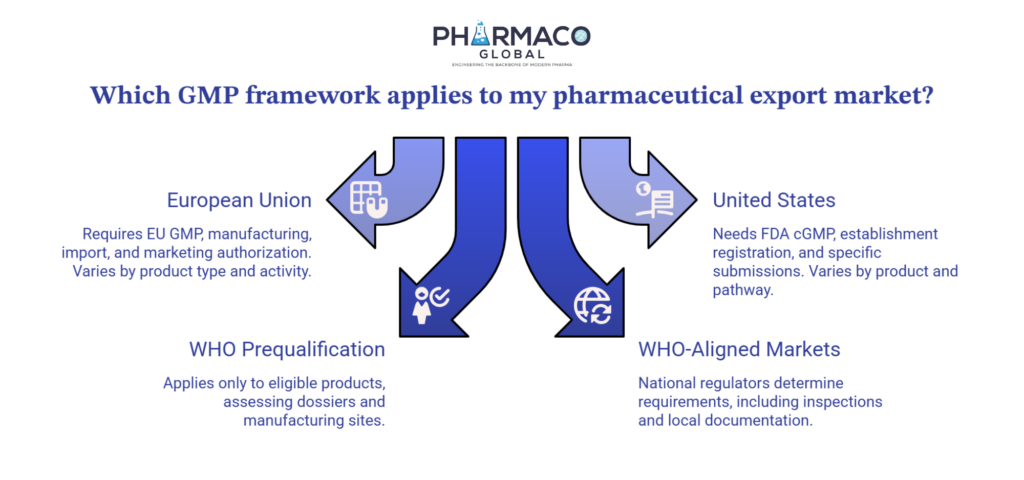
Exporting Pharmaceutical Products to the European Union
Products supplied to the EU must meet applicable EU GMP, manufacturing, import and marketing-authorization requirements.
Requirements vary by product and activity:
- APIs: EU GMP Part II, relevant ICH Q7 principles and API import controls
- Finished products: Part I, applicable annexes and approved dossier commitments
- Sterile products: Annex 1 and a documented contamination control strategy
- Imported finished products: Import testing and Qualified Person certification
- Investigational or biological products: Applicable product-specific requirements
A non-EU site may be inspected by the relevant EU or EEA competent authority unless an accepted mutual-recognition or reliance pathway applies. An EU GMP certificate does not replace manufacturing or import authorization, marketing authorization or batch-release obligations.
Exporting Pharmaceutical Products to the United States
Manufacturers supplying the United States must meet applicable FDA cGMP requirements and support the relevant product, establishment and import pathway.
Depending on the product, this may include:
- Drug-establishment registration and listing
- An NDA, ANDA, BLA or other applicable submission
- Identification of manufacturing, testing and packaging sites
- FDA inspection or facility assessment
- Evidence of cGMP compliance
- Import-admissibility requirements
FDA establishment registration is an administrative requirement. It does not mean that the facility or its products are FDA-approved. Companies should therefore avoid unsupported terms such as “FDA-certified facility.”
For U.S.-bound products,cGMP manufacturing controls should be aligned with the applicable application, establishment, and import pathway rather than presented as a standalone USFDA cGMP certificate.
WHO Prequalification and WHO-Aligned Markets
WHO prequalification applies only to eligible health products. It assesses the product dossier and the compliance of relevant manufacturing sites through inspections, desk assessments, or accepted regulatory evidence.
This differs from exporting to a country that refers to WHO GMP guidance. In these markets, the national regulator determines:
- Which GMP evidence it accepts
- Whether it will inspect the facility
- Whether a CPP or local dossier is required
- Whether local testing, registration or representation is needed
- Whether foreign documents require verification or legalization
Countries using WHO GMP guidance do not follow one uniform approval pathway. Exporters should prepare a country-by-country regulatory matrix covering the required certificates, dossiers, inspections and local market-access steps.
A WHO-GMP certificate may support an EU or US submission, but it does not independently provide access to either market. The destination regulator decides whether the inspection evidence is acceptable.
How Do EU GMP, WHO GMP and USFDA cGMP Requirements Compare in Practice?
EU GMP, WHO GMP and FDA cGMP share core expectations for effective quality systems, trained personnel, controlled facilities, validated processes and reliable records. Their main differences lie in regulatory terminology, validation frameworks, batch-release responsibilities and inspection outcomes. This distinction is central to any GMP vs GMP review because shared quality principles can be implemented through different legal and inspection systems.
| Area | Shared expectation | Key practical distinction |
| Quality systems | Procedures must be implemented, documented and reviewed | Terminology and documentation formats vary |
| Data integrity | Records must be complete, secure, traceable and reviewable | EU Annex 11, FDA requirements and WHO guidance structure controls differently |
| Facilities and utilities | Systems must be suitable for the product, process and manufacturing risk | Product type has more influence on design than the regulator’s name alone |
| Qualification and validation | Facilities, equipment and processes must remain fit for intended use | EU Annex 15 and FDA lifecycle guidance organize evidence differently |
| Batch release | Manufacturing and quality records must be reviewed before release | The EU uses a legally defined Qualified Person role for applicable medicinal products |
| Inspection outcomes | Authorities assess whether operations meet applicable requirements | EU and FDA use different records, classifications and enforcement processes |
Pharmaceutical Quality Systems and Data Integrity
All three frameworks require a functioning pharmaceutical quality system, not simply approved procedures.
Companies should be able to demonstrate consistent control of:
- Documentation and training
- Deviations, investigations, CAPA and change control
- Supplier and product oversight
- Data governance and record integrity
For example, an audit-trail procedure provides little assurance unless reviews are completed, documented and followed by investigation where required.
EU Annex 11, FDA requirements and WHO data-integrity guidance use different terminology, but all expect controls such as unique user access, secure raw data, audit trails, backups, controlled administrator privileges and documented review.
Facilities, Equipment and Utilities
All three frameworks require facilities, equipment and utilities to be suitable for their intended use and capable of preventing contamination, mix-ups and operational errors.
The required controls depend primarily on the product, process and quality risk. A sterile facility, oral solid dosage plant and high-potency API facility will therefore require different approaches to zoning, containment, HVAC, cleaning and environmental control.
These same risk-based decisions apply to cGMP manufacturing, where facility and utility suitability must be demonstrated for intended use.
Qualification and Process Validation
Qualification and validation should demonstrate that facilities, utilities, equipment and processes remain suitable throughout their lifecycle. When stakeholders ask what cGMP is in pharma, qualification and validation provide part of the answer by showing that systems remain fit throughout their lifecycle.
EU Annex 15 covers activities such as DQ, IQ, OQ, PQ and process validation. FDA guidance organizes process validation into three stages:
- Process design: Define the commercial process using product and process knowledge.
- Process qualification: Confirm that the facility, equipment, and process can support reproducible manufacturing.
- Continued process verification: Review routine production data to confirm ongoing control.
For multi-market projects, one integrated CQV strategy can address common requirements, with market-specific evidence added where necessary.
Teams working to EU GMP guidelines should map Annex 15 evidence into the integrated CQV plan without duplicating common lifecycle controls.
Batch Release and Outsourced Activities
All three frameworks require documented batch review and an authorized quality decision before release.
The EU has a defined Qualified Person certification requirement for applicable medicinal products. FDA and WHO also require controlled batch review and disposition, although the legal roles and titles differ.
Outsourcing manufacturing, testing, engineering or qualification does not remove the pharmaceutical company’s quality responsibility. Technical and quality agreements should clearly define responsibilities for changes, deviations, investigations, data access and release decisions.
Inspections, Observations and CAPA Closure
Inspection terminology and outcomes differ across authorities.
EU competent authorities may issue a GMP certificate or statement of non-compliance for the assessed scope. FDA may issue a Form FDA 483 when investigators identify conditions that may violate applicable requirements. A Form 483 is not FDA’s final compliance decision.
A credible regulatory response should address:
- Immediate correction or containment
- Root cause and impact assessment
- Corrective and preventive actions
- Responsible owners and timelines
- Evidence of completion and effectiveness
Internal CAPA closure does not automatically mean that the regulator considers the issue resolved. Inspection outcomes may support EU GMP certification, but only for the activities and scope assessed by the competent authority.
How GMP Strategy Affects Pharmaceutical Facility Design and Construction
GMP strategy influences facility layouts, personnel and material flows, HVAC, utilities, equipment, automation, and qualification. These requirements should be defined before major design and procurement decisions are finalized. Late regulatory changes can lead to redesign, construction rework, repeated qualification, and production delays.
What Is a Regulatory Design Basis?
A regulatory design basis translates the product, process, and target-market strategy into clear requirements for facility design, construction, commissioning, and qualification.
It should define:
- Markets: Initial and future export markets and expected inspection pathways
- Products: Dosage forms, batch sizes, production scale, and commercial or investigational use
- Processes and risks: Sterile or non-sterile manufacturing, containment, and contamination risks
- Facility requirements: Cleanrooms, HVAC, utilities, equipment, and automation
- Compliance approach: Applicable GMP requirements, CQV strategy, data controls, and batch-release responsibilities
- Future needs: Expansion, new products, and potential technology transfers
Quality assurance, regulatory affairs, production, engineering, validation, EHS, and project owners should agree on the design basis before layouts and system capacities are fixed.
For sterile facilities, it should also define the contamination control strategy, cleanroom grades, barrier technology, sterilization methods, interventions, and environmental monitoring.
Without an approved design basis, engineering, QA, and commercial teams may work from different assumptions, increasing the risk of unsuitable systems and late project changes.
Which Facility Systems Are Most Affected by GMP Strategy?
| Design area | Key GMP considerations |
| Site planning and zoning | Production areas, warehouses, hazardous materials, waste routes, access control, and future expansion |
| Personnel and material flows | Gowning, airlocks, sampling, dispensing, production, packaging, and waste movement |
| Contamination control | Segregation, containment, pressure relationships, cleaning, and environmental monitoring |
| HVAC and cleanrooms | Cleanliness level, filtration, airflow, temperature, humidity, and product risk |
| Clean utilities | Purified water, WFI, clean steam, process gases, and compressed air |
| Equipment and automation | Cleaning, containment, process control, data capture, maintenance, and qualification |
| Supporting systems | Laboratories, warehousing, digital infrastructure, data integrity, and maintenance access |
There is no single standard layout for an “EU GMP,” “WHO GMP,” or “FDA cGMP” facility. Design decisions should be based on the product, process, applicable regulatory pathway, and quality risk.
How Does Product Type Change GMP Facility Design?
| Facility or product type | Key design implications |
| API manufacturing | Solvent handling, hazardous-area classification, containment, reaction control, and effluent management |
| Oral solid dosage | Dust extraction, dispensing controls, cleaning, and product-changeover management |
| Sterile products | Classified areas, barrier systems, sterilization, airflow control, and environmental monitoring |
| Biological products and vaccines | Biosafety, segregated processing, decontamination, and cold-chain systems |
| Highly potent products | Closed transfer, negative pressure, safe-change filtration, and occupational-exposure controls |
| Combination products | Integrated controls for pharmaceutical and device components |
The GMP facility design strategy should therefore begin with the product and manufacturing process—not only the destination regulator. For design teams asking what cGMP in pharma is, the facility implications begin with the product, process, contamination risks, and intended market.
Greenfield vs Brownfield GMP Projects
| Project type | Main opportunity | Main risk |
| Greenfield facility | Greater freedom to plan zoning, utility capacity, expansion space, and multi-market requirements | Incorrect regulatory assumptions can still lead to unsuitable flows, systems, or contamination controls |
| Brownfield upgrade | Existing infrastructure may reduce initial construction needs | Fixed layouts, shared systems, active production, and incomplete documentation may restrict design options |
Greenfield projects can include future utility connections, expansion areas, and data capacity from the start. However, additional space and new equipment cannot correct an unclear process or regulatory strategy.
Brownfield projects may require:
- Phased construction and controlled shutdowns
- Temporary personnel or material routes
- Verification of existing drawings and system capacity
- Assessment of legacy equipment and automation
- Requalification and controlled restart planning
Quality-risk management should assess how construction and system changes may affect ongoing production, product quality, and supply.
Regulatory, QA, engineering, manufacturing, commercial, and finance teams should approve the main product, market, and capacity assumptions before each design stage is closed. Adding sterile manufacturing, highly potent products, or new export markets later may require revised layouts, HVAC, containment, data controls, qualification evidence, and batch-release arrangements.
Designing for One or Multiple GMP Markets
Project teams should decide early whether the facility will support one defined market, multiple markets from launch, or selected future expansion. The decision should reflect the product portfolio, regulatory pathways, facility life, capital limits and expected business growth.
| Consideration | One-market strategy | Multi-market strategy |
| Best suited for | A defined launch market and limited product portfolio | A planned export programme covering several regulated markets |
| Main advantage | Lower initial complexity and capital commitment | Greater flexibility for new products, clients and technology transfers |
| Primary risk | Future market entry may require costly modifications | Unnecessary requirements may increase cost and operational complexity |
| Design approach | Meet current requirements while preserving justified expansion options | Establish a common GMP baseline and add market-specific controls |
| Key decision | Which future provisions should be included now? | Which requirements are genuinely common, specific, or unnecessary? |
For multi-market planning, the project should prepare a regulatory requirements matrix that classifies each requirement as:
- Common: Applicable across the selected markets
- Market-specific: Required by a particular authority or regulatory pathway
- Product-specific: Driven by the dosage form, process or manufacturing risk
- Future provision: Included to support planned products, markets or capacity
This matrix should guide decisions on layouts, utilities, equipment, automation, data systems and CQV planning.
The common GMP baseline should be scientifically and commercially justified rather than created by combining the most demanding requirements from every guideline. Overdesign can increase capital cost, energy use, maintenance, and qualification effort without delivering a proportionate benefit. Underdesign can result in expensive modifications when a new product, client, or market is added.
The objective is to create a scalable facility that meets current requirements while preserving only those future capabilities supported by a realistic business and regulatory plan.
Pharmaco Global: Align GMP Strategy with Facility Design from Day One
A GMP facility should not be designed first and assessed for compliance later. Product requirements, target markets, and regulatory expectations must shape the facility before layouts, HVAC zoning, utility capacities, es and equipment specifications are fixed.
Pharmaco Global brings regulatory and engineering teams into the project early to translate those requirements into practical design decisions across:
- Conceptual design: Feasibility, zoning, personnel and material flows, and initial HVAC and utility strategy
- Basic and detailed engineering: Room data, equipment layouts, P&IDs, automation, electrical design and construction documentation
- GMP-critical systems: Cleanrooms, HVAC, purified water, WFI, pure steam and equipment integration
- Regulatory readiness: Gap assessments, documentation support, mock audits and inspection preparation
Its structured engineering process includes more than 102 deliverables across multiple design disciplines, helping project teams maintain traceability from early planning through construction and qualification.
By coordinating GMP planning, engineering, system supply and regulatory readiness through one team, Pharmaco Global helps reduce design gaps, late-stage rework and delays caused by fragmented project ownership.
Discuss Your GMP Facility Strategy
Pharmaco Global supports greenfield developments and brownfield upgrades by aligning facility design, HVAC, clean utilities, equipment integration, CQV, and regulatory-readiness requirements from the start.
To discuss a GMP gap assessment, multi-market facility plan, brownfield remediation program, or qualification-led inspection-readiness project, contact the Pharmaco Global team or follow us at www.pharmacoglobal.com.
FAQs
What is the main difference between EU GMP, WHO GMP, and USFDA cGMP?
EU GMP is enforced across the EU and EEA, FDA cGMP governs medicines for the United States, and WHO GMP guides national regulators and defined WHO programs. They share core quality principles but differ in legal authority, inspection pathways, compliance evidence, and international market-access requirements.
Is GMP the same as cGMP in pharmaceutical manufacturing?
GMP and cGMP are not separate compliance tiers.cGMP means current Good Manufacturing Practice and emphasizes keeping facilities, methods, equipment, and controls suitable for present operations. EU GMP and WHO GMP are also updated as scientific knowledge, technology, manufacturing practices, and regulatory expectations continuously evolve.
What is cGMP in pharma?
cGMP in pharma means current Good Manufacturing Practice. It covers the systems, facilities, equipment, processes, controls, and records used to manufacture medicines consistently. FDA enforces cGMP requirements to help ensure drug products meet their stated identity, strength, quality, and purity throughout routine commercial manufacturing operations.
Does the US FDA issue a cGMP certificate to pharmaceutical manufacturers?
No. FDA does not issue a universal cGMP certificate that permanently approves an entire pharmaceutical facility or every product it manufactures. FDA assesses compliance through inspections, application reviews, records, and ongoing oversight, although it may issue cGMP declarations or specific export documents in defined circumstances.
Who issues a WHO GMP certificate?
A WHO-GMP certificate is generally issued by the national regulatory authority that inspected the manufacturing site under its own laws or procedures. WHO publishes GMP standards and a model certificate format, but it does not directly issue every document described commercially as a WHO-GMP certificate.
Is a WHO GMP certificate valid for pharmaceutical exports to Europe?
Not by itself. A WHO-GMP certificate may support an EU regulatory submission, but European market access requires EU GMP compliance, import and manufacturing authorizations, marketing authorization, and batch-certification arrangements. The relevant EU competent authority decides whether the submitted inspection evidence is acceptable for that scope.
Can an EU GMP-certified site export pharmaceutical products to the United States?
Not automatically. An EU GMP-certified site must still meet applicable FDA cGMP, product-application, establishment-registration, drug-listing, and import requirements. Under the EU-US mutual recognition agreement, FDA may rely on qualifying EU inspection results, but it retains authority to assess or inspect the facility independently when necessary.
How can a company verify an EU GMP certificate?
Search the public EudraGMDP database using the manufacturer name, site address, or certificate details. Review the issuing authority, inspected address, authorized activities, dosage forms, certificate number, and status. Questions about validity or scope should be directed to the issuing competent authority for formal written confirmation.
Which GMP framework should a new pharmaceutical facility be designed to meet?
A new pharmaceutical facility should be designed around its intended products, manufacturing processes, target markets, and regulatory pathways. Establish a justified common GMP baseline, then add market-specific, product-specific, and future provisions. Designing only to a generic “EU,” “WHO,” or “FDA” facility label is not sufficient.
Do EU-US mutual recognition agreements eliminate the need for inspections?
No. The EU-US mutual recognition agreement reduces duplicate GMP inspections by allowing regulators to rely on inspection results from the other party. It does not eliminate every inspection. Authorities retain the right to inspect when risk, compliance history, evidence gaps, or other concerns justify assessment.