For Vietnamese manufacturers, EU GMP certification involves defining the intended product and market, aligning with an EU importer and regulatory pathway, closing facility and quality-system gaps, completing qualification and validation, and passing an inspection. QA, engineering, regulatory affairs, validation, production, and senior management must work together because the route depends on the product, activities, importer, marketing authorisation, and responsible EU authority.
At a glance, the manufacturer must define the product and target market, establish the EU regulatory route, assess compliance gaps, remediate the facility, implement an effective Pharmaceutical Quality System, complete commissioning, qualification and validation, prepare inspection documentation, undergo the regulatory inspection, close deficiencies and verify the resulting certificate in EudraGMDP.
What Does EU GMP Certification Mean for Vietnamese Pharmaceutical Manufacturers?
In practical terms, an EU GMP certificate records the compliance status of an inspected manufacturing site. It is limited to the address, manufacturing operations, dosage forms, and scope assessed by the competent authority. It should not be presented as unrestricted, company-wide accreditation covering every product or operation.
What EU GMP Compliance Demonstrates
Compliance demonstrates that suitable controls exist for personnel, premises, equipment, utilities, materials, production, quality control, documentation, validation, data integrity, and the Pharmaceutical Quality System within the inspected scope. These controls must operate consistently rather than exist only as policies prepared for an inspection.
EU GMP vs Vietnam WHO-GMP Requirements
WHO-GMP and EU GMP both support the consistent manufacture and control of quality medicines. In an EU GMP vs WHO GMP comparison, the principal differences concern regulatory jurisdiction, inspection pathways, EU importation arrangements, Qualified Person involvement and market-specific expectations. Existing WHO-GMP compliance can provide a strong foundation, but it does not automatically establish compliance with the applicable EU scope.
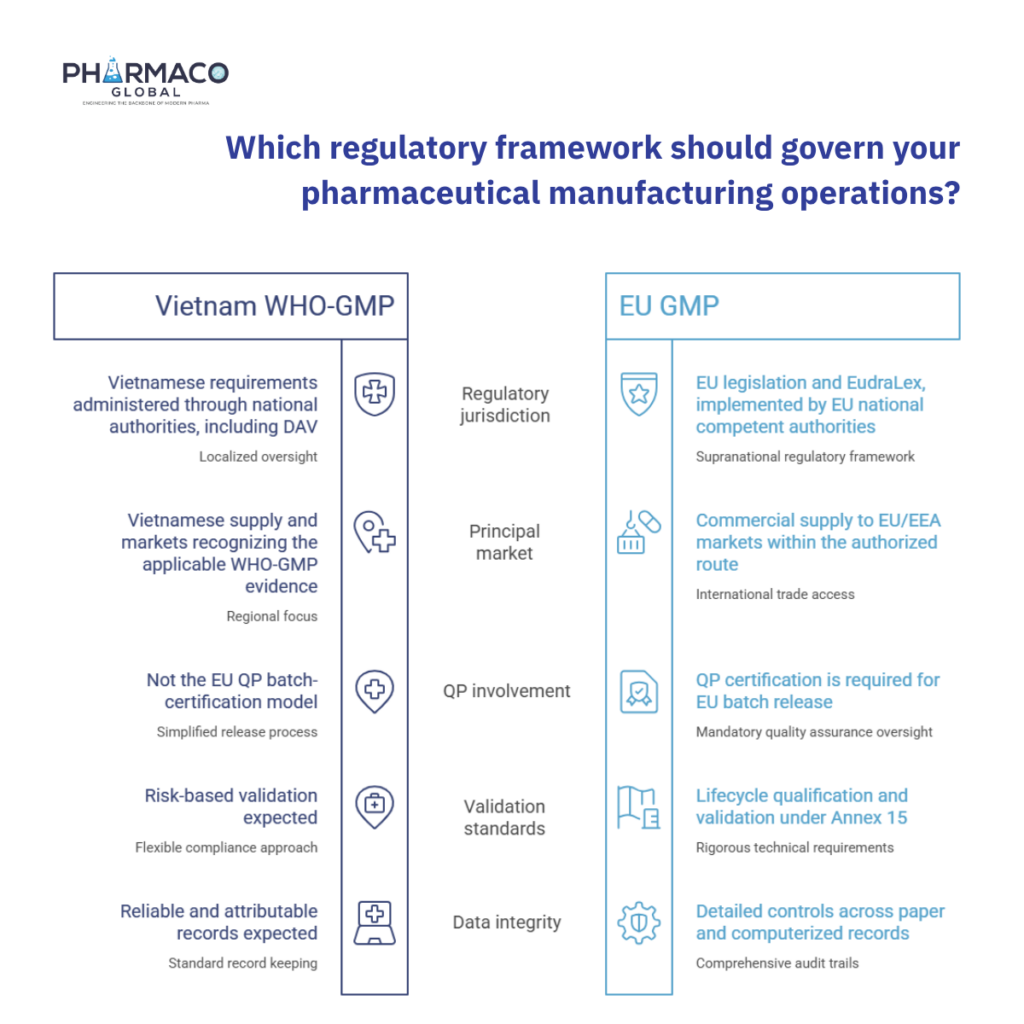
Exact obligations depend on the product, manufacturing activities, marketing-authorisation route and inspection scope.
Is EU GMP Certification Required to Export Medicines to the EU?
EU commercial supply generally requires more than a successful site inspection. The product needs an appropriate marketing-authorisation route, an EU importer holding the required Manufacturing and Importation Authorisation, supply-chain oversight, applicable testing and QP batch certification. A customer audit or voluntary readiness review cannot replace these regulatory arrangements.
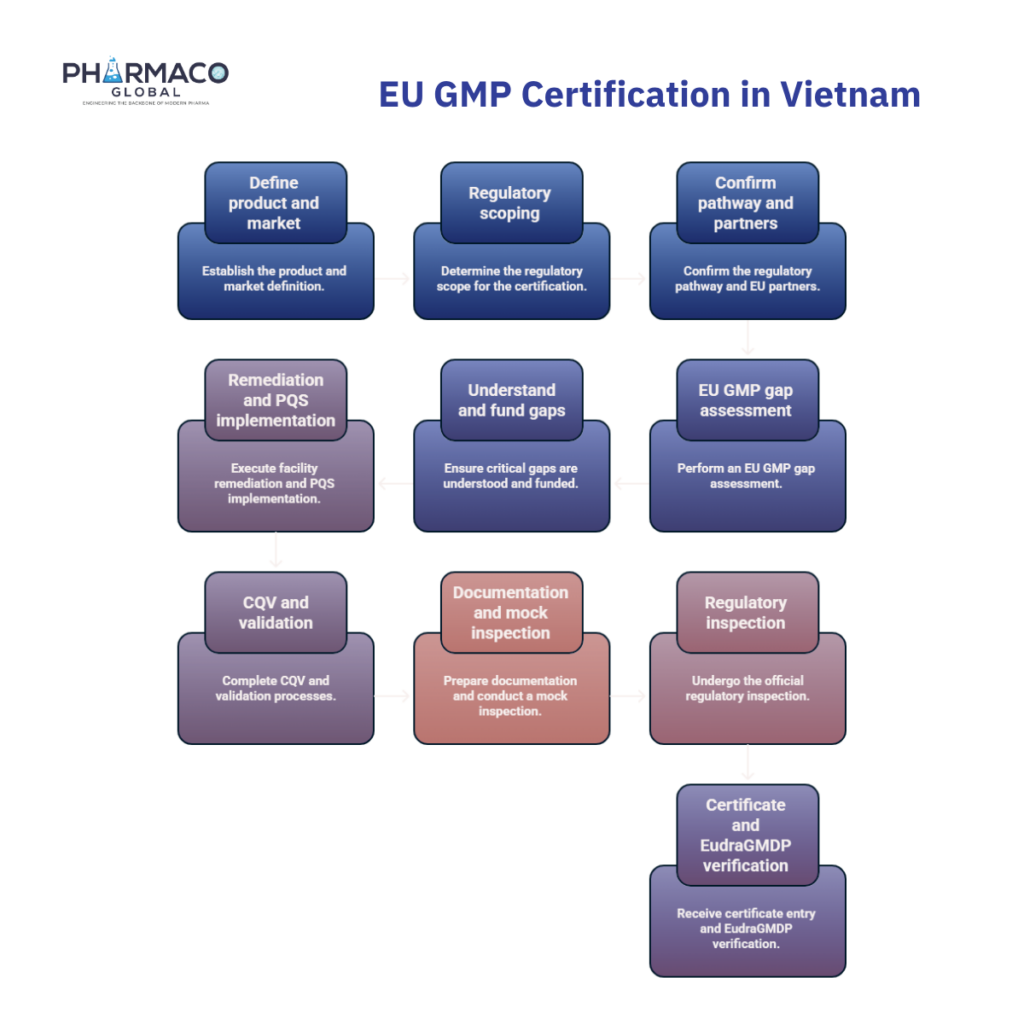
How to Get EU GMP Certification in Vietnam: 11 Steps
The workstreams may overlap. Their duration and sequence depend on the dosage form, current compliance maturity, inspection pathway and whether the project involves a brownfield retrofit or a new pharmaceutical plant.
The 11-step EU GMP certification process
- Define the product, dosage form, activities and target EU market.
- Confirm the regulatory pathway, importer, MAH, MIA holder and QP.
- Assess the site against applicable EU GMP requirements.
- Remediate the facility, equipment and critical utilities.
- Establish an effective Pharmaceutical Quality System.
- Complete commissioning, qualification and validation.
- Prepare the Site Master File and inspection records.
- Conduct mock inspections and role-specific training.
- Complete the competent authority’s regulatory inspection.
- Respond to deficiencies and verify CAPA effectiveness.
- Confirm the certificate and authorised scope in EudraGMDP.
Step 1: Define the Product, Dosage Form and Target EU Market
Identify the product type, dosage form, batch size, manufacturing stages, testing responsibilities and intended Member States. Sterile status, containment needs and commercial route influence cleanroom design, utilities, equipment, validation scope, documentation and the activities that inspectors are expected to assess.
Product and market scoping checklist
- Product type and dosage form
- Proposed batch size and production line
- Sterile or non-sterile status
- Containment and cross-contamination risks
- Target Member States
- Intended importer and MAH pathway
- Manufacturing and testing locations
- Storage and transport conditions
- Technology-transfer requirements
- Planned launch date
Step 2: Select the Regulatory Pathway and EU Partners
Identify the MAH, importer or MIA holder, QP, testing arrangements, regulatory adviser and likely national competent authority before finalising the project scope. EMA coordinates certain activities, but national competent authorities normally conduct third-country inspections and issue certificates. DAV remains responsible for applicable Vietnamese oversight.
Searches for “EMA site inspection Vietnam” can therefore be misleading: EMA does not directly inspect and certify every Vietnamese site. Similarly, “MHRA Vietnam” relates primarily to the separate UK pathway because the United Kingdom is no longer an EU Member State.
Major construction should not begin until the intended products, activities, markets and regulatory route have been confirmed.
Responsibilities of the Manufacturer, Importer, MAH, MIA Holder and QP
The Vietnamese manufacturer controls its operations, records, suppliers and outsourced activities. The importer manages compliant entry into the EU. The MIA holder operates under its authorisation, while the MAH remains accountable for the authorised product. The QP requires access to manufacturing, testing, deviation and supply-chain information before certifying a batch.
EU GMP Project Governance and Responsibility Matrix
Readiness is not a QA-only programme. Senior management must provide governance and resources, while QA, QC, engineering, production, validation, regulatory affairs, procurement, warehouse, IT, EHS and external delivery specialists coordinate through approved decisions, risk reviews and controlled handovers.
Step 3: Conduct an EU GMP Gap Assessment
Assess premises, utilities, processes, the PQS, validation status, laboratories, computerised systems, documentation, data integrity, organisation and inspection history against the applicable EudraLex chapters and annexes. Rank gaps by patient risk, product-quality impact, compliance significance, cost, schedule and operational disruption.
Step 4: Upgrade the Pharmaceutical Facility and Utilities
Convert assessment findings into one coordinated remediation plan covering process risks, capacity, contamination control, personnel and material movement, utilities, equipment, maintenance, monitoring and records. Design controls should be proportionate to the dosage form and process rather than copied from a generic “EU GMP plant” template.
Cleanroom Zoning and Personnel and Material Flows
Define room classifications, pressure relationships, airlocks, changing stages, pass boxes and segregation according to product risk. Map personnel, materials, samples, equipment, waste and rejected goods so that crossing routes and uncontrolled backtracking do not undermine contamination or mix-up controls. Sterile requirements apply only where relevant.
HVAC and Environmental-Control Requirements
The HVAC strategy should address airflow direction, filtration, differential pressure, temperature, humidity, recovery, alarms and monitoring. Qualification may include airflow visualisation, cleanroom classification, filter-integrity testing and recovery studies. The acceptance criteria must reflect the process and applicable room grade.
Pharmaceutical Water and Critical Utility Systems
Assess water generation, storage and distribution, compressed gases, clean steam where applicable, electrical resilience, control systems and monitoring. Sampling, sanitisation, preventive maintenance and qualification should be defined from system risks and intended use; one water or utility configuration is not suitable for every facility.
Warehouses, Laboratories, Equipment and Waste Movement
Provide controlled status identification for quarantined, released, rejected and returned materials. Address temperature-controlled storage, sampling, laboratory segregation, equipment access, calibration, maintenance, hazardous materials, waste holding and controlled removal. Layouts should permit operation, cleaning and maintenance without creating unassessed product risks.
Retrofit an Existing Facility or Construct a New Plant?
A retrofit may use existing infrastructure but can face shutdowns, restricted ceiling space, inadequate utility capacity and hidden conditions. A new facility offers greater layout freedom but requires higher capital and extensive start-up qualification. The decision should compare lifecycle risk, expansion, schedule certainty, validation burden and operational continuity.
Step 5: Establish the Pharmaceutical Quality System
The PQS should control quality policy, responsibilities, documents, deviations, CAPA, changes, complaints, recalls, self-inspection, suppliers, quality risks, product-quality reviews and management review. Procedures must accurately describe operations and produce evidence of effective implementation, ownership and continual improvement.
Step 6: Complete Commissioning, Qualification and Validation
Create traceability from user requirements and risk assessments through design qualification and validation, FAT, SAT, commissioning, IQ, OQ and PQ. Add process, cleaning, analytical method, transport and computerised system validation as applicable. Commissioning evidence may support qualification when controlled and assessed, but it is not automatically a substitute for GMP qualification.
Deviations, acceptance criteria and design changes should remain traceable throughout the lifecycle.
Step 7: Prepare the Site Master File and Inspection Documents
Prepare a current Site Master File, quality manual, organisation charts, SOPs, validation master plan, batch records, qualification files, deviations, CAPAs, changes, training records, supplier files, stability data, complaints, recalls and product-quality reviews. Inspectors should find consistency between documents, systems and shop-floor practices.
Step 8: Conduct Mock Inspections and Train Employees
Simulate document requests, facility walkthroughs, employee interviews, batch-traceability exercises, deviation investigations and data-integrity reviews. Prepare QA, engineering, production, QC, warehouse, IT, validation and leadership for their actual responsibilities. Employees should provide accurate, evidence-based answers rather than memorise scripts that may conflict with real practice.
Step 9: Complete the EU GMP Regulatory Inspection
The authority normally confirms the scope and requests documentation before the inspection. Activities may include an opening meeting, facility tour, system-based reviews, record sampling, interviews, batch tracing, utility and equipment review, computerised-system assessment, daily discussions, and a closing meeting. Duration varies with scope and findings.
Step 10: Respond to Deficiencies and Implement CAPA
For each observation, assess patient and product risk, contain immediate issues, determine the underlying root cause, and define corrective and preventive actions. Assign accountable owners, realistic dates, and objective evidence. Verify effectiveness rather than closing actions because a new SOP or training attendance sheet has been issued.
Step 11: Obtain and Verify the GMP Certificate in EudraGMDP
Certificate issuance depends on the inspection outcome, the adequacy of the manufacturer’s responses, and the authority’s follow-up decision. Search EudraGMDP using the company, site, country, authority, certificate number, or activity, then verify the address, dosage forms, authorised operations, restrictions, and inspection scope.
Common Reasons EU GMP Projects in Vietnam Face Delays or Findings
Delays usually arise when engineering, quality systems, validation, documentation, and governance are managed as separate initiatives. Weak early decisions then emerge during qualification or inspection, when correction is more disruptive and expensive.
Facility Design and Operating Procedures Do Not Match
Typical problems include incorrect pressure relationships, impractical personnel or material flows, inaccessible maintenance zones, crowded equipment and difficult cleaning. Inspectors may also find undocumented workarounds or SOPs that describe an idealised process rather than the way employees operate the facility.
Qualification, Validation or Data Integrity Is Incomplete
Weak URS documents, missing traceability, unjustified acceptance criteria and unresolved deviations undermine qualification. Computerised-system findings may involve excessive access, uncontrolled spreadsheets, inadequate audit-trail review, incomplete backups or systems that were validated initially but not maintained in a controlled state.
Contamination Control, Supplier Oversight or Training Is Weak
Common weaknesses include inadequate cleaning controls, poorly justified environmental monitoring, incomplete supplier qualification, weak contractor oversight and generic training. Recurring deviations often indicate that CAPAs addressed individual events without correcting the underlying process, design or management-system failure. Sterile controls should be applied where the product scope requires them.
How to Maintain EU GMP Compliance After Certification
A certificate reflects the inspected site, status and scope at a point in the regulatory lifecycle. It does not replace continuous compliance. Manufacturers must sustain the PQS, manage facilities and processes in a validated state, and evaluate product, process and regulatory changes throughout the lifecycle.
Maintain an Effective Pharmaceutical Quality System
Continue reviewing deviations, CAPA effectiveness, changes, complaints, recalls, suppliers, self-inspections, product-quality reviews and quality risks. Management review should use meaningful trends to identify resource constraints, recurring failures and opportunities for continual improvement.
Keep Facilities, Utilities and Processes in a Validated State
Maintain preventive maintenance, calibration, monitoring, periodic review and risk-based requalification. Trend environmental and utility performance, continue process verification and assess the validation impact of equipment, software, process, supplier and facility changes before implementation.
Maintain Continuous Inspection Readiness
Use recurring self-inspections, targeted mock inspections, traceability exercises, refresher training and rapid document-retrieval tests. Keep the Site Master File current, review finding trends and periodically confirm that EudraGMDP information still matches the site address, activities and applicable certificate scope.
What Are the Benefits of EU GMP for Pharmaceutical Companies in Vietnam?
EU GMP readiness can support regulatory submissions, export relationships, contract-manufacturing opportunities, technology transfer, partner confidence and more mature quality systems. It may also help pharmaceutical companies in Vietnam demonstrate that the inspected site operates to requirements expected within the EU supply route.
These benefits require sustained investment in people, engineering, utilities, validation, digital controls and governance. A certificate alone does not guarantee a marketing authorisation, tender award, customer contract, sales volume or commercial success. Its value depends on the product strategy, authorised supply chain and continued compliance.
Start Your EU GMP Certification Journey With Pharmaco Global
Preparing a pharmaceutical facility in Vietnam for EU GMP certification requires regulatory, engineering, quality, validation, and operational workstreams to progress as one coordinated program. Pharmaco Global combines pharmaceutical facility engineering with in-house regulatory expertise to support manufacturers across greenfield developments, brownfield upgrades, and inspection-readiness projects.
Coordinate Every Workstream From Gap Assessment to Inspection Readiness
- Assess facility and compliance gaps: Evaluate infrastructure, utilities, quality systems, documentation, validation status, and operating practices against the intended EU GMP scope.
- Plan and execute facility upgrades: Translate identified gaps into GMP-aligned layouts, cleanroom zoning, HVAC systems, critical utilities, equipment requirements, and controlled personnel and material flows.
- Prepare documentation and teams: Support qualification and validation documentation, Site Master File and SOP preparation, mock audits, CAPA planning, facility walkthroughs, and employee inspection-readiness training.
- Support the regulatory pathway: Coordinate dossier preparation, QP submission, inspector queries, physical-inspection preparation, and responses to observations through the applicable certification process.
By connecting regulatory expectations with facility design and execution from the outset, Pharmaco Global helps manufacturers reduce coordination gaps, prioritise remediation activities, and move toward inspection readiness through a clearer and more controlled EU GMP project roadmap.
Discuss your EU GMP facility or readiness project.
Planning an EU GMP facility, upgrade, or inspection-readiness program? Pharmaco Global can help you assess compliance gaps, define the required engineering and regulatory workstreams, and build a practical EU GMP roadmap from facility remediation through qualification, validation, and inspection preparation.
Talk to Pharmaco Global about your EU GMP gap assessment, brownfield remediation, or inspection-readiness roadmap.
FAQs
How can a Vietnamese pharmaceutical manufacturer get EU GMP certification?
Define the product and EU market, appoint the required EU partners, assess the site against applicable EudraLex requirements, remediate gaps, implement the PQS, complete qualification and validation, prepare inspection records, undergo the competent authority’s inspection, close deficiencies and verify the certificate in EudraGMDP.
What are the main EU GMP requirements for pharmaceutical manufacturers in Vietnam?
Requirements cover trained personnel, suitable premises, controlled utilities and equipment, documented production and testing, an effective PQS, lifecycle validation, reliable records, data integrity, supplier oversight and controlled computerised systems. The applicable requirements depend on the product, activities, dosage form and inspection scope.
How long does the EU GMP certification process in Vietnam take?
No universal timeline applies. A limited remediation programme may be shorter than a major retrofit or greenfield facility. Duration depends on design and procurement scope, equipment lead times, validation, documentation maturity, EU partner readiness, inspection scheduling and the number and significance of deficiencies.
How can buyers verify an EU GMP certificate for a Vietnamese manufacturer?
Search the public EudraGMDP database by company, site, country, issuing authority, certificate number or manufacturing activity. Confirm the exact address, inspection date, dosage forms, authorised operations and restrictions. Do not rely only on a certificate image supplied by the manufacturer.