
If an inspector arrived next quarter, could your leadership team prove that the site is in control without launching a last-minute search for drawings, qualification records, deviations, and missing approvals?
That is the real test behind an MHRA or EU GMP inspection.
For a Southeast Asian manufacturer pursuing UK or European market access, the inspection does not stop at SOPs. It can expose whether the Pharmaceutical Quality System, facility, HVAC, utilities, equipment, data, and day-to-day operations tell the same story. If they do not, the consequence may extend beyond a corrective action: an application, launch, supply commitment, or capital plan can come under pressure.
Executive answer: MHRA and EU inspectors look for a demonstrable state of control. They test whether management oversight, records, facilities, utilities, qualification, production, laboratories and external partners consistently support the approved process. At sterile sites, EU GMP Annex 1 adds particular scrutiny to the Contamination Control Strategy (CCS), cleanroom design, first-air protection, barrier systems, interventions and environmental control.
The leadership decision is not simply, “Are we inspection-ready?” It is:
Can the existing operating system remove the risk, or is the site asking procedures to compensate for a facility that needs engineering, requalification, or capital intervention?
Why an Overseas GMP Inspection Is a Market-Access Event
The MHRA confirms that non-UK manufacturing sites used by UK marketing-authorization holders can fall within its GMP oversight and that overseas manufacturing sites are inspected. Its programme includes risk-based, product-related and triggered inspections. In the EU system, national competent authorities normally conduct inspections, while the European Medicines Agency (EMA) coordinates relevant activity and uses inspectors from EU Member States for centrally connected procedures.
This matters because inspection readiness can sit directly on the critical path to commercial execution. Limited relevant inspection history, an unresolved compliance concern, a new product or manufacturing site, or a significant change may draw regulatory attention when the business is trying to secure or expand market access.
Senior leaders should therefore treat readiness as part of enterprise risk, not as a QA event added to the audit calendar.
Who Actually Inspects: MHRA, EMA or a National Authority?
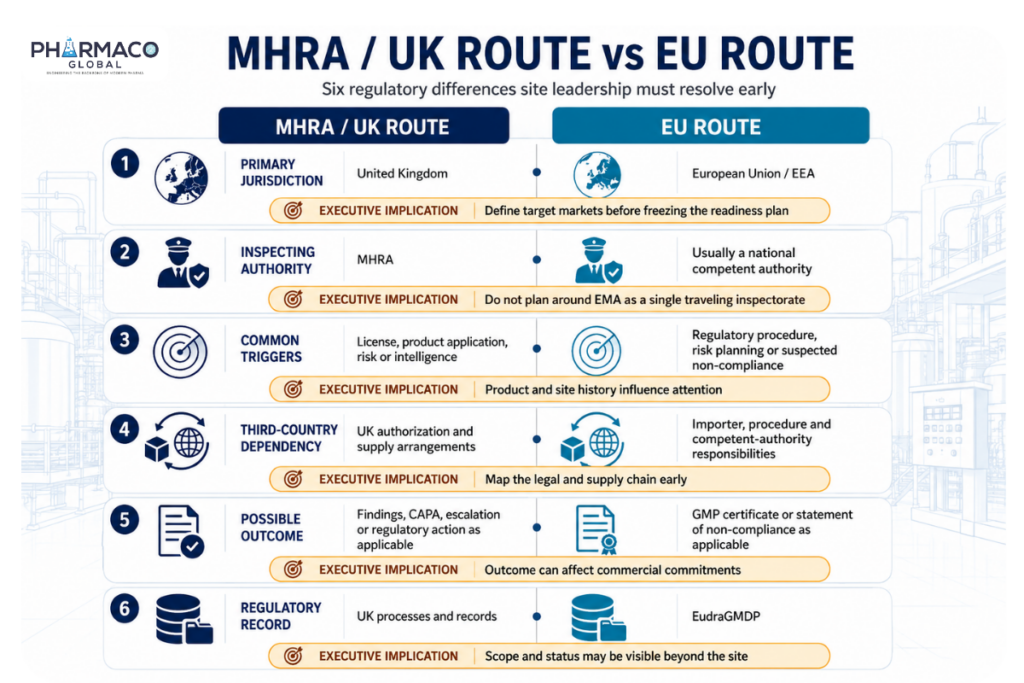
The phrase “EMA inspection” is widely used, but it can obscure who will actually arrive at the site. That distinction affects the regulatory pathway, the importer relationship, the evidence route and the inspection scope.
MHRA inspections of sites outside the UK
The MHRA can inspect overseas manufacturers relevant to UK supply. Its published guidance states that manufacturers are inspected when applying for a license and then periodically according to risk; product-related inspections may also support UK marketing-authorization applications. Triggered inspections can follow information suggesting a possible GMP breach and may come with little or no notice.
EU inspections of third-country sites
In the EU, GMP inspections are generally carried out by national competent authorities. EMA coordinates specified inspection activity, particularly where centralized procedures or several authorities are involved. For a third-country site, the relevant importer, product procedure, manufacturing activities, inspection history and applicable recognition arrangements help determine which authority becomes central.
What Brexit changed for site leadership
The UK and EU now have separate regulatory pathways. A manufacturer serving both markets may need to manage distinct regulatory relationships and evidence routes. What did not change is the need to show a functioning Pharmaceutical Quality System, controlled manufacture, reliable data, and facilities fit for their intended use.
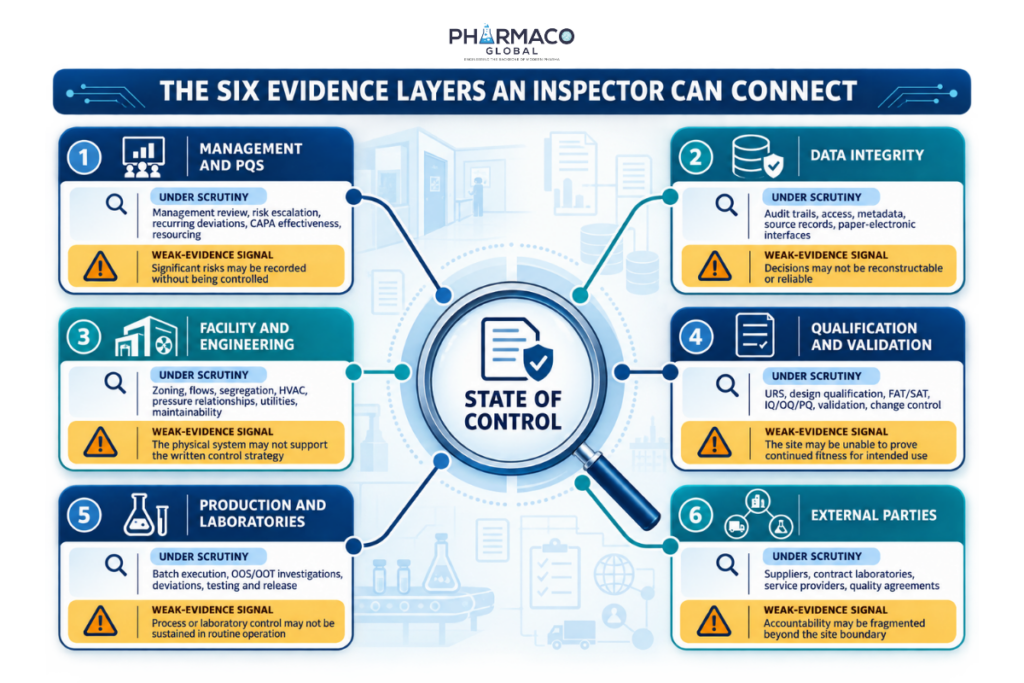
What Inspectors Are Really Testing: Can the Site Prove Control?
Inspectors do not assess functions in isolation. They move across systems and look for consistency. An SOP may describe the intended control; an operator interview shows how the work is understood; a batch or audit trail shows what occurred; and the facility walkthrough reveals whether the physical environment makes that control credible.
This creates a powerful inspection test:
Requirement → design → installation → qualification → operation → monitoring → change
If the chain breaks, the issue is no longer only a missing document. It becomes a question about the reliability of the state of control.
Management oversight: recurrence is the warning signal
One deviation can be an event. A repeating pattern is a governance question.
Inspectors can look beyond individual CAPAs to ask whether management review detects systemic risk, whether owners have the authority and resources to close it, and whether effectiveness checks prove that recurrence has stopped. MHRA post-inspection guidance specifically asks companies responding to major deficiencies to consider the wider systemic issue rather than correct only the cited example.
For the board or executive committee, overdue investigations and repeatedly extended CAPAs are not administrative metrics. They may be early indicators that the organization has accepted a control weakness it cannot resolve within normal operations.
Data integrity: can a critical decision be reconstructed?
The practical data-integrity question is straightforward: can the site reconstruct how a result, deviation, batch decision or release decision was created, reviewed and changed?
The MHRA’s GxP data-integrity guidance addresses governance across the data lifecycle, including the reliability and completeness of records. Inspectors may examine user access, audit trails, metadata, transcriptions and hybrid paper-electronic processes when these affect the credibility of evidence.
Facility, HVAC and utilities: does the building support the claim?
A controlled process cannot be separated from the environment in which it runs. Personnel and material flows, segregation, cleanroom zoning, pressure cascades, airflow, temperature, humidity, and clean utilities can all determine whether the process is capable of remaining within its qualified state.
The red flag is inconsistency. If approved drawings show one configuration, qualification records describe another, and the walkthrough reveals a third, management may need to defend not only document control but the continued validity of the engineered system.
Qualification: does the evidence follow the final installation?
EU GMP Annex 15 expects user requirements to define quality requirements and be followed through the validation lifecycle. Design qualification, FAT/SAT where appropriate, installation qualification, operational qualification and performance qualification should create traceability to the installed and operating system.
That becomes commercially important after brownfield changes. A technically successful modification can still leave an inspection risk if as-built drawings, system boundaries, qualification protocols, SOPs, training and routine monitoring do not all reflect the final state.
When EU GMP Annex 1 Turns a Facility Gap Into a Capital Decision
For sterile manufacturing, EU GMP Annex 1 makes contamination control a site-wide system. It connects the Pharmaceutical Quality System with premises, equipment, utilities, personnel, materials, processes, maintenance, cleaning, monitoring, CAPA, and continuous improvement.
This is why a sterile-site observation can move quickly from QA to the executive agenda. The root cause may sit in room geometry, pressure stability, HVAC capacity, barrier configuration, intervention design, or clean-utility performance—areas that cannot be corrected by issuing another SOP.
A CCS must describe the real control system
A polished Contamination Control Strategy is not persuasive if the facility cannot execute it. The CCS should connect identified contamination risks to the controls that actually operate at the site and to the evidence that those controls remain effective.
Leadership should be concerned when the CCS assumes conditions that are not consistently supported by:
- pressure and airflow performance;
- first-air protection at critical operations;
- intervention design and operator behavior;
- barrier technology and transfer practices;
- environmental and process monitoring;
- maintenance, cleaning and disinfection;
- qualification and change-control evidence.
Barrier technology is not a substitute for an integrated design
Annex 1 directs manufacturers to consider technologies such as RABS and isolators to reduce contamination risk from direct human intervention. The presence of a barrier, however, does not settle the inspection question. Inspectors can still test whether transfers, glove use, interventions, airflow, decontamination, surrounding-room classification, and monitoring work as one control system.
Legacy infrastructure changes the remediation equation
Older cleanrooms are not automatically non-compliant. They become an executive risk when physical constraints make reliable control difficult or force routine dependence on procedural workarounds.
Signals include unstable pressure relationships, conflicting flows, frequent open interventions, hard-to-clean surfaces, inadequate segregation, limited utility capacity, or qualification evidence that no longer matches the installed system. At that point, a rapid CAPA may create the appearance of closure while leaving the underlying exposure in place.
The Southeast Asian Evidence Gap Is About Regulatory Fit, Not Geography
Southeast Asian manufacturing is not inherently less compliant. The gap appears when a site designed, licensed, or operated for one market must support a different UK or EU product, importer, and inspection pathway.
A domestic license and a strong local inspection history remain important evidence, but they do not by themselves establish readiness for every export scope. Leadership must test whether the existing site, systems and evidence are fit for the intended product and market.
Regional operating realities should be built into that assessment. Variable ambient conditions, utility resilience, outsourced laboratories, regional suppliers, translated records and long service chains are not deficiencies by themselves. They become risks when their effects are not understood, qualified, governed or readily defensible.
For manufacturers assessing an EU pathway from Vietnam, Pharmaco Global’s EU GMP certification guide for Vietnamese pharmaceutical manufacturers explains how product scope, importer arrangements, gap assessment, remediation, and inspection preparation connect.
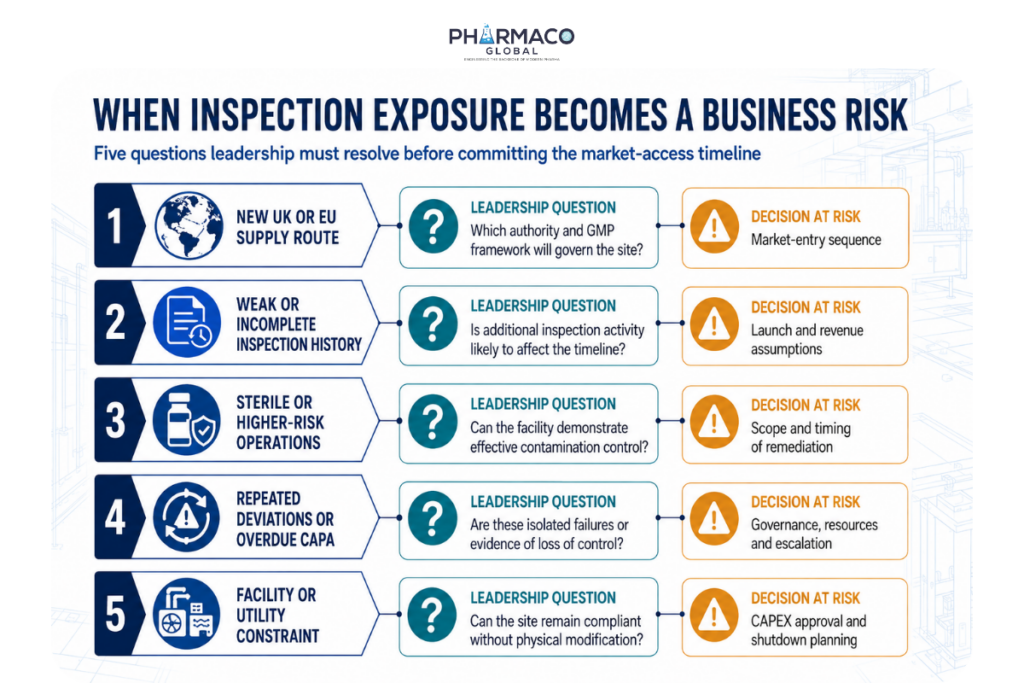
Seven Questions the Executive Team Should Answer Before Committing the Timeline
This is not an inspection checklist. It is a capital and market-access test.
- What exact UK or EU pathway must this site support? Name the product, activities, importer or authorization route, and probable authority.
- Which unresolved issue could alter the commercial timeline? Separate routine observations from risks that can delay approval, supply, or a major customer commitment.
- Where does each major risk originate? Classify it as governance, procedure, data, process, qualification, engineering, or facility design.
- Does the physical site still match approved and qualified evidence? Reconcile drawings, system boundaries, change control, and as-built conditions.
- Can critical systems remain in control during worst credible operating conditions? Consider peak load, recovery, maintenance, interventions, and utility interruption—not only normal operation.
- What is the long-lead remediation dependency? HVAC equipment, cleanroom modification, utilities, barrier systems, shutdown access, and requalification can determine the real schedule.
- Who owns the integrated outcome? QA, engineering, production, validation, and regulatory teams need one governed plan, not separate lists that converge shortly before inspection.
If leadership cannot answer these questions with current evidence, the inspection-readiness date is still an assumption.
What Happens If Inspectors Find That the System and Site Do Not Match?
MHRA inspectors may interview personnel, review documents, and visit any relevant facility or process. They may also change the inspection focus if serious non-compliance is suspected. Findings are graded as critical, major or other; several related “other” deficiencies can collectively indicate a major failure.
The business consequence depends on depth, not just count.
- A contained procedural weakness may require correction, investigation and an effectiveness check.
- A systemic quality failure may demand wider review, governance changes and sustained evidence of recovery.
- A facility or utility failure may require design work, procurement, shutdown, construction, commissioning and requalification.
- Under the EU system, inspection activity can result in a GMP certificate or, where appropriate, a statement of non-compliance recorded in EudraGMDP.
- Under the UK process, an unacceptable response or significant unresolved non-compliance can lead to compliance escalation or regulatory action.
The post-inspection response is therefore not the moment to discover that a proposed completion date depends on unavailable shutdown time or a long-lead engineered system. MHRA guidance asks for realistic timelines, attention to wider systemic issues, and interim controls when a longer-term action is necessary.
Build an Inspection-Ready Pharmaceutical Facility with Pharmaco Global
Inspection readiness is decided long before an inspector arrives. It depends on whether facility design, qualification records, and daily operation describe the same level of control, and on whether a site can correct engineering-driven risks at the source instead of asking procedures to absorb them.
Pharmaco Global helps Southeast Asian manufacturers pursuing UK and EU market access close that gap through one coordinated program spanning facility engineering, clean utilities, qualification, and regulatory readiness. Requirements from EU GMP Annex 1, Annex 15, and MHRA and EU GMP inspection practice are built into design and execution, not added as documentation after construction.
Address Compliance Risks Before They Become Inspection Findings
An inspection finding is usually the visible end of a gap that existed for years. The work beforehand is to locate those gaps while there is still time to fix them, and to separate risks a procedure can close from risks that need engineering, requalification, or capital intervention.
Pharmaco Global runs facility-led gap assessments that test a site against its intended UK or EU scope, not its existing domestic approvals.
Facility and utility gap analysis: Site walkdowns evaluate layout, segregation, personnel and material flows, HVAC, pressure cascades, and clean utilities against real operating conditions, so a physical constraint is never logged as a procedural observation.
Qualification and as-built reconciliation: Approved drawings, system boundaries, and Annex 15 qualification records are traced to the installed system, surfacing the design-versus-walkthrough mismatches that inspectors read as a control-reliability question.
Contamination control review for sterile sites: For Annex 1 operations, the Contamination Control Strategy is verified against actual pressure and airflow performance, first-air protection, barrier and intervention design, and monitoring data, rather than the conditions it assumes.
Each gap is classified by the remediation it requires, showing leadership which exposures can be closed in normal operations and which sit on the long-lead engineering and capital path.
From GMP-Compliant Design to Regulatory Readiness
A gap is only useful once it can be closed and defended in front of an inspector. Pharmaco Global turns gap findings into GMP-aligned engineering, executes the work around live production where needed, and maintains the evidence chain from user requirements through qualification, so the finished facility and its records match.
Engineering and brownfield remediation: Findings become user requirements, design criteria, and specifications for cleanroom, HVAC, and clean-utility work. Live-site modifications are planned around production windows, controlled isolation, construction segregation, and safe return to service.
Commissioning, qualification, and validation: The evidence chain runs from design review through commissioning, IQ, OQ, PQ, and process or cleaning validation, so qualification records reflect the final as-built facility.
Inspection-readiness preparation: Site Master File and SOP support, mock audits, CAPA planning, facility walkthroughs, and staff inspection-readiness training test the site before an MHRA or EU authority does.
Coordinating engineering, system supply, qualification, and regulatory readiness through one team reduces handover gaps, prioritizes remediation, and moves manufacturers toward inspection readiness on a controlled timeline instead of a last-minute one.
Discuss Your Inspection-Readiness Program
Pharmaco Global designs, remediates, and qualifies pharmaceutical facilities to EU GMP, FDA, and WHO requirements across greenfield builds and live-site retrofits, and prepares manufacturers for MHRA and EU GMP inspections tied to UK and European market access.
To discuss a facility gap assessment, brownfield remediation program, or qualification-led inspection-readiness roadmap, contact the Pharmaco Global team.
FAQs
Can the MHRA inspect a pharmaceutical manufacturing site outside the UK?
Yes. The MHRA states that overseas manufacturing sites are inspected where UK GMP oversight requires it. Inspection may be linked to licensing, product applications, risk assessment, or intelligence about possible non-compliance.
Does EMA directly inspect pharmaceutical sites in Vietnam?
Usually, the inspection team comes from an EU national competent authority. EMA coordinates specified inspection activity and European procedures; it does not operate as the only routine inspectorate for every third-country site.
Does EU GMP Annex 1 apply to every pharmaceutical facility?
No. Annex 1 applies to the manufacture of sterile medicinal products. Some principles may be applied to certain non-sterile products where justified, but the full sterile-manufacturing framework does not automatically apply to every facility.
Can an SOP update close an HVAC, cleanroom, or utility gap?
Not if the root cause is physical. A procedure can define how a capable system should be operated; it cannot create missing capacity, correct poor segregation, stabilize an inadequate pressure cascade, or replace qualification evidence.
Can documentation alone prove inspection readiness?
No. Readiness depends on alignment between intended controls, records, personnel practice, and observable site conditions. Inspectors can test all four.
When should leadership involve an engineering and CQV partner?
When the probable root cause affects layout, HVAC, clean utilities, barrier systems, equipment integration, qualification, or a significant brownfield change, these issues need coordinated regulatory, design, execution, and lifecycle evidence.
How long does MHRA or EU GMP inspection readiness take?
There is no universal duration. The timeline depends on inspection scope, site maturity, remediation depth, design and equipment lead times, shutdown access, qualification, operating evidence, and the closure of significant deficiencies.