For a Vietnamese pharmaceutical manufacturer planning EU market entry, the most expensive question is not, “Can this site pass an EU GMP inspection?”
It is this: Can the existing facility support the intended product and EU supply model without creating an open-ended remediation programme, an unmanageable shutdown, or stranded CAPEX?
That distinction matters. A conventional compliance audit may identify hundreds of observations. It may still leave the board without a defensible investment decision. A decision-grade EU GMP gap analysis for a Vietnam pharma facility must connect regulatory requirements with facility constraints, system performance, product risk, business continuity, and the cost of sustainable remediation.
For senior management, the outcome should be a clear choice: retain and remediate the site, build a new production block, move to a greenfield facility, or reconsider the proposed EU scope before committing more capital.
Executive answer: An EU GMP gap analysis for a pharmaceutical facility in Vietnam is a risk-based assessment of whether the site, systems, organization, and evidence can support a defined EU product and supply scope. It should identify material gaps, test brownfield feasibility, classify remediation priorities, estimate CAPEX and shutdown exposure, and produce an executable readiness roadmap. It is not an EU inspection or a GMP certificate.
What Must an EU GMP Gap Analysis Decide for a Vietnam Pharma Facility?
The assessment must do more than compare current procedures with EudraLex. It must show management whether the proposed route from the existing Vietnam facility to EU supply is technically achievable, commercially rational, and operationally sustainable.
The Real Decision Is Investment Readiness
EU GMP readiness is often treated as a Quality Assurance project. In reality, it is an enterprise investment decision involving QA, regulatory affairs, engineering, production, supply chain, finance, and executive leadership.
Before approving a remediation budget, management should have credible answers to seven questions:
- Can the current site support the intended product, process, capacity, and control strategy?
- Which buildings, utilities, assets, and digital systems can be retained, modified, requalified, upgraded, or replaced?
- Which gaps create material patient-safety, product-quality, data-integrity, or inspection risk?
- What CAPEX, OPEX, shutdown, schedule, and resource exposure follows?
- Which long-lead systems or construction constraints could control the market-entry date?
- Are the importer, MIA holder, testing strategy, QP certification model, and quality agreements aligned with the facility plan?
- Does brownfield remediation create more lifecycle value than a new production block or greenfield facility?
If the assessment cannot answer those questions, it is not yet decision-grade.
A Checklist Cannot Reveal the Full Exposure.
EU GMP requirements span EudraLex Volume 4 Part I, product- and activity-specific annexes, and the wider authorization and importation route. Applicability changes with dosage form, manufacturing stage, process risk, system use, and supply-chain design.
A universal checklist can therefore generate false confidence. It may give equal visual weight to a documentation improvement and an HVAC capacity limitation that could require a six-month shutdown. It may also classify an importer or QP dependency as “outside site scope” even when that dependency controls market access.
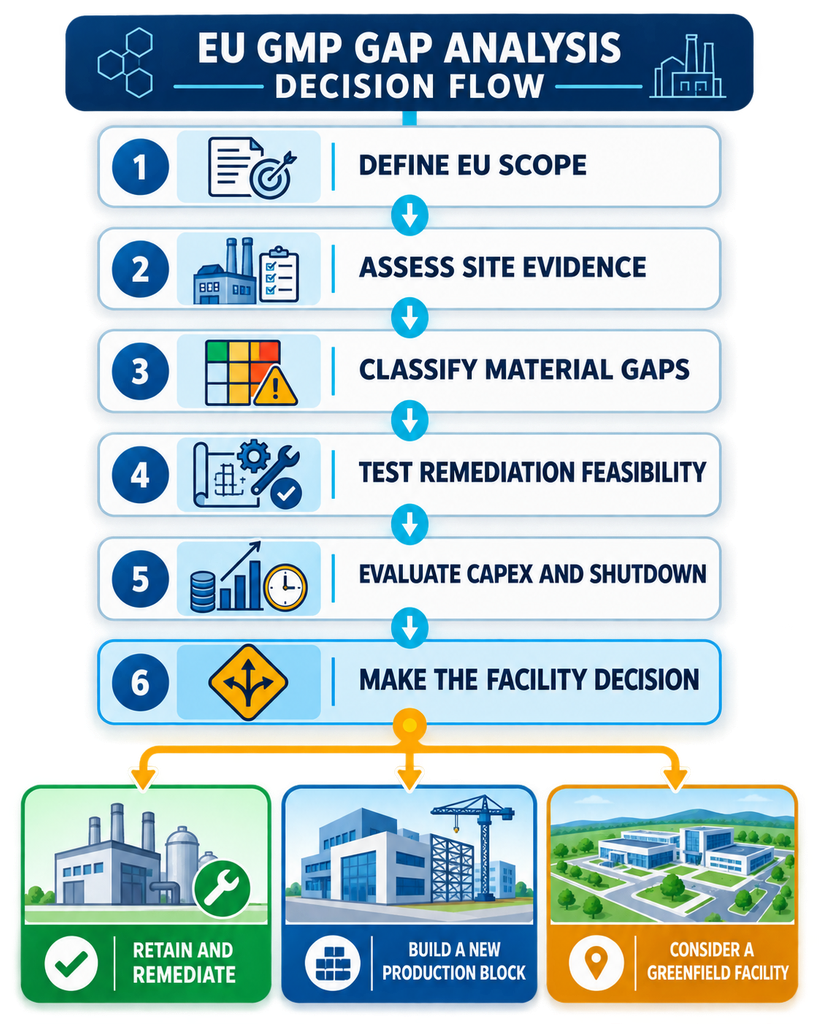
This sequence keeps the programme focused on outcomes rather than observation counts.
Lock the Regulatory Boundary Before an EU GMP Upgrade
The wrong assessment boundary leads to the wrong CAPEX. For a pharmaceutical facility in Vietnam, approve product scope, facility scope, and EU supply responsibilities before intensive document review, site walkdowns, or concept engineering begins.
Confirm the Current Vietnam GMP Baseline
“DAV GMP” is widely used search language, but it should not be treated as a standalone technical GMP standard. The Drug Administration of Vietnam operates within Vietnam’s Ministry of Health framework, while the site’s baseline depends on its licensed scope and the GMP principles applied.
Circular 28/2025/TT-BYT, effective from 1 July 2025, is the current Ministry of Health circular governing GMP for medicinal products and medicinal materials. Its official appendices include WHO-GMP, PIC/S GMP, and EU GMP principles. It replaced Circular 35/2018/TT-BYT, Circular 12/2022/TT-BYT, and the relevant provision of Circular 29/2020/TT-BYT, subject to stated transitional arrangements.
The Drug Administration of Vietnam published a draft amendment to Circular 28/2025/TT-BYT in June 2026. As of 19 August 2026, it remains a draft and should be monitored, not applied as an effective requirement.
This matters commercially. An EU GMP assessment based on an obsolete Vietnam regulatory baseline can misstate existing compliance, duplicate remediation, or miss new obligations that affect the investment case.
Define the Product and Operating Model
The phrase “upgrade the factory to EU GMP” is too broad for engineering or regulatory decisions. Management should define:
- Product families and dosage forms
- Sterile, non-sterile, biological, potent, or low-bioburden status
- Manufacturing, primary packaging, secondary packaging, testing, storage, and release activities
- Batch sizes, campaign strategy, and planned EU volumes
- Dedicated, shared, or multiproduct areas and equipment
- Laboratories, warehouses, clean utilities, automation, and outsourced services in scope
- The building, block, line, or campus boundary being assessed
The difference is material. A non-sterile tablet line using shared dispensing creates a different risk and investment profile from an aseptic filling line supported by classified areas, sterile utilities, and barrier technology.
Scope should become a controlled project document. Otherwise, each function may evaluate a different future facility.
Map the EU Import and Release Route
Facility remediation alone does not create an EU supply route. For a pharmaceutical manufacturer in Vietnam, the planned model should identify the target EU or EEA markets, Marketing Authorization Holder, importer, Manufacturing and Import Authorization holder, QP certification site, testing arrangements, contract laboratories, logistics route, and quality agreements.
EU GMP Annex 21 summarises GMP requirements for MIA holders importing medicinal products. Annex 16 addresses QP certification and batch release.
Map these external responsibilities into the readiness programme early. A fully remediated manufacturing building can still miss its commercial date if the importer, testing model, QP oversight, dossier, or quality agreements are unresolved.
Separate Readiness From EU GMP Certification
An advisory assessment can evaluate readiness, define remediation, support design, and prepare the organization for inspection. It cannot issue an EU GMP certificate or guarantee an inspection outcome.
Following an inspection, the national competent authority that carried it out may issue a GMP certificate when compliance is confirmed. The certificate or a statement of non-compliance may then be entered in EudraGMDP.
This distinction protects the programme from a common governance error: treating “gap closure” as equivalent to regulatory approval. Management should track advisory readiness, engineering completion, qualification, validation, inspection, certification, and market authorization as separate milestones.
Where EU GMP Upgrade Programs in Vietnam Lose Time and Capital
The largest risks are rarely isolated SOP gaps. They occur where product requirements, legacy infrastructure, digital controls, and project sequencing intersect.
Facility Flows and Contamination Control
Challenge an existing facility layout under real operating conditions, not only against approved drawings. Personnel, materials, components, samples, waste, equipment, and maintenance routes should remain controlled during overlapping batches, interventions, cleaning, and abnormal events.
Procedural sequencing may manage an occasional interface. It is a weak long-term answer when routine operations depend on perfect timing, temporary barriers, or repeated exceptions.
For multiproduct facilities, the assessment should connect product characteristics with containment, dust extraction, pressure strategy, closed transfer, cleaning access, campaign controls, and health-based exposure considerations. Where the control strategy cannot be operated consistently, physical modification is usually more credible than another procedural layer.
Executive trigger: If segregation relies on behavior that cannot be observed, measured, or sustained at peak production, the site may carry residual risk even after the CAPA is closed.
HVAC, Cleanrooms, and Clean Utilities
Acceptable at-rest results do not prove that the facility can support the intended process. Test HVAC capacity and control under realistic occupancy, equipment heat loads, extraction demand, door movement, seasonal conditions, and recovery scenarios.
Management needs to know whether the current system can be rebalanced and requalified or whether the EU GMP upgrade requires new air-handling capacity, distribution changes, controls, or technical-space expansion.
Assess clean utilities together with their dependencies. A qualified water system is not resilient if a single chiller, boiler, electrical feeder, control platform, or drainage constraint can take it outside its validated state. Peak demand, redundancy, sanitization recovery, critical spares, maintainability, and future capacity all influence the investment decision.
For sterile operations, the current EU GMP Annex 1 requires a contamination control strategy that connects facility, equipment, utilities, personnel, processes, and monitoring. It does not support evaluating each of these as an isolated workstream.
Equipment, Automation, and Data Integrity
Asset age is not a reliable retain-or-replace rule. A mature machine may remain defensible if it is cleanable, maintainable, supportable, controlled, and qualified in its current configuration. A newer system may create greater exposure if privileged access, audit trails, metadata, interfaces, backup, or lifecycle support are weak.
Each major asset should receive an investment classification:
- Retain: Suitable, supportable, and adequately evidenced
- Remediate: A defined deficiency can be corrected without changing the core asset
- Requalify: The configuration is suitable, but lifecycle evidence is incomplete or outdated
- Upgrade: Controls, containment, automation, or performance need material improvement
- Replace: Sustainable compliance or lifecycle support cannot be demonstrated economically
For computerized systems, follow critical data from creation to review, reporting, backup, archival, and retrieval. Apply Annex 11 expectations to GMP systems such as production controls, LIMS, chromatography platforms, BMS, EMS, spreadsheets, and hybrid records.
The important question is not whether an audit-trail feature exists. It is whether governance and review can detect unauthorized, unexplained, or consequential changes.
Laboratories, Warehousing, PQS, and Validation
EU GMP readiness can fail outside the manufacturing suite. Laboratories may lack capacity for expanded testing, stability, microbiology, or environmental-monitoring demand. Warehouses may have weaknesses in status control, sampling, temperature mapping, printed-component security, or system-downtime handling.
Test the Pharmaceutical Quality System through performance. Repeat deviations, aging CAPAs, overdue investigations, ineffective actions, uncontrolled changes, and weak management escalation reveal more than the number of approved procedures.
Qualification and validation evidence should also form one lifecycle. The current installed state should trace back through user requirements, design, supplier testing, commissioning, qualification, change control, and release. Repeating a validation exercise will not correct an unstable utility, inaccessible product-contact surface, or uncontrolled software configuration.
ICH Q9(R1) states that risk assessments should use evidence, science, and knowledge. That principle should govern gap classification and remediation decisions. A generic red-amber-green score should not replace it.
Is a Brownfield EU GMP Upgrade Viable for a Vietnam Pharma Facility?
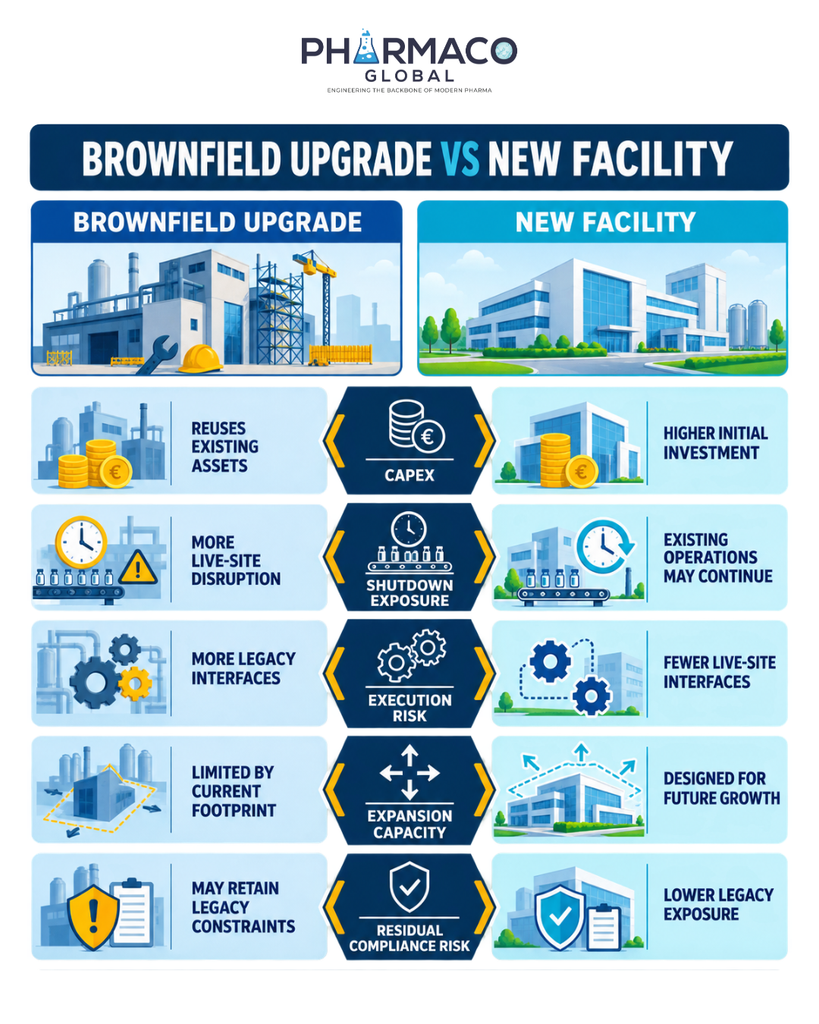
A brownfield upgrade is viable only when the remediated site can sustain the required control strategy at an acceptable lifecycle cost and residual risk. Reusing an existing building in Vietnam is not automatically the lower-cost decision.
When Brownfield Remediation Makes Sense
Brownfield remediation is more credible when the building can accommodate required flows, utilities, containment, equipment, and maintainability without disproportionate enabling work. The site should also have a realistic shutdown strategy and sufficient remaining asset life.
Favorable indicators include:
- Core building and structural capacity remain suitable
- HVAC and utility systems have recoverable capacity or practical expansion routes
- Material and personnel flows can be corrected without rebuilding the production block
- Key equipment can be supported and brought into a defensible lifecycle state
- Construction can be segregated from live GMP operations
- Requalification and restart can be sequenced without unacceptable supply risk
- The solution preserves future capacity and technical-space options
Brownfield can be faster for a focused scope. It becomes less attractive when each retained system creates another interface, temporary control, or shutdown dependency.
When a New Block or Greenfield Facility Becomes Stronger
A new production block or greenfield project may create greater value when legacy constraints prevent a robust future state. Typical triggers include structural limitations, inadequate segregation, congested utility routes, obsolete automation, insufficient technical space, weak expansion potential, or a shutdown that threatens customer supply.
The decision should compare total lifecycle outcomes, not only construction CAPEX.
Use a Formal Decision Gate
Management should not wait until detailed design to discover that the brownfield option is structurally weak. For a Vietnam EU GMP upgrade, a formal feasibility gate should compare:
- Required control strategy and capacity
- Retain, modify, upgrade, and replace scope
- Enabling works and hidden interfaces
- CAPEX range and estimate maturity
- Production shutdown and inventory requirements
- Schedule and long-lead procurement
- Qualification and validation burden
- Residual regulatory and operational risk
- Future expansion and lifecycle OPEX
The output should recommend an option, show the assumptions behind it, and identify which unresolved facts could still change the decision.
What Should Management Receive From an EU GMP Assessment?
The final package should allow QA, engineering, operations, finance, and leadership to work from one risk picture. For a Vietnam pharma facility, separate reports built on different assumptions can create avoidable execution risk.
Decision-Grade Deliverables
At minimum, an EU GMP gap assessment should provide:
- Executive decision and risk summary
- Approved product, facility, and EU supply-chain scope
- Applicable requirements and evidence matrix
- Prioritized gap register with quality and business consequences
- Facility, HVAC, utility, equipment, laboratory, automation, PQS, and validation findings
- Retain, remediate, requalify, upgrade, or replace matrix
- Brownfield feasibility and option comparison
- Defined remediation work packages
- Preliminary CAPEX range with estimate basis and exclusions
- Shutdown and business-continuity strategy
- Integrated engineering, CQV, validation, and readiness schedule
- Governance and responsibility matrix
- Closure criteria, open decisions, assumptions, and residual risks
The executive summary should make the recommended decision clear. Senior leaders should not have to interpret hundreds of findings to understand whether the site remains investable.
Warning Signs in an EU GMP Assessment Proposal
Before appointing a provider for a Vietnam facility, challenge any approach that:
- Starts with a generic checklist before product and supply scope are agreed
- Separates regulatory observations from engineering feasibility
- Provides a CAPEX figure without design maturity, assumptions, and exclusions
- Uses observation count as the main measure of risk
- Treats SOP revision or training as the default closure for technical gaps
- Excludes importer, MIA, QP, or testing dependencies from the readiness plan
- Promises certification or guarantees an inspection outcome
- Cannot convert findings into buildable and qualifiable work packages
The strongest provider is not the one that produces the longest gap list. It is the one that helps management avoid the wrong investment.
Plan Your EU GMP Facility Upgrade in Vietnam With Pharmaco Global
Before approving brownfield CAPEX or committing to an EU market-entry date, leadership needs more than a compliance checklist. It needs a clear view of whether the existing Vietnam facility can support the intended product and supply scope, what must change, and whether the investment remains commercially viable.
Pharmaco Global supports this decision by combining EU GMP gap assessment with pharmaceutical engineering, execution, and qualification expertise. This prevents the assessment from becoming a QA-only report that engineering must reinterpret later.
Turn Facility Gaps Into an Investment Roadmap
Pharmaco Global begins by defining the intended product, operating model, facility boundary, and EU supply route. The assessment then focuses on the areas most likely to influence compliance, CAPEX, shutdown, and schedule, including facility flows, cleanrooms, HVAC, clean utilities, equipment, data integrity, the Pharmaceutical Quality System, and qualification evidence.
Each material gap is linked to the action it genuinely requires, whether that is procedural correction, requalification, engineering modification, system upgrade, or replacement.
- What can be retained, remediated, upgraded, or replaced
- Which gaps sit on the long-lead engineering or shutdown path
- Whether brownfield remediation remains preferable to a new facility
- What must be completed before inspection readiness
The result is a prioritized remediation strategy that helps leadership stage investment, manage business interruption, and protect the proposed market-entry timeline.
Support From EU GMP Assessment Through Readiness
When remediation is required, Pharmaco Global can translate the findings into coordinated work packages covering facility design, cleanroom zoning, HVAC, clean utilities, equipment integration, commissioning, and qualification. Its in-house cleanroom and HVAC capabilities help maintain continuity between the approved design intent and installed performance.
Regulatory-readiness support can progress alongside the physical upgrade through validation documentation, SOP and Site Master File support, mock audits, QP coordination, and inspection preparation. This integrated approach reduces handoffs between QA, engineering, suppliers, and CQV teams while keeping responsibilities and dependencies within one roadmap.
For senior management, the advantage is clearer accountability from assessment through readiness. Regulatory inspection and certification remain the responsibility of the applicable competent authority, but the facility approaches that stage with stronger technical evidence and a more controlled readiness programme.
Request an EU GMP Gap Assessment in Vietnam
Establish what your facility can support, where investment is required, and whether the brownfield strategy remains viable before approving the upgrade budget.
Request an EU GMP gap assessment from Pharmaco Global to evaluate your Vietnam facility and build a prioritized remediation roadmap from assessment through inspection readiness.
FAQs
Can a WHO-GMP Facility in Vietnam Be Upgraded to EU GMP?
Yes, some WHO-GMP-aligned facilities in Vietnam can be upgraded for a defined EU product and supply scope. Feasibility depends on facility flows, contamination control, utilities, data integrity, qualification evidence, system lifecycle, shutdown exposure, and remediation cost. WHO-GMP alignment is useful baseline evidence, but it does not prove EU GMP readiness.
Is an EU GMP Gap Analysis the Same as an EU Inspection?
No. A gap analysis is an advisory assessment used to evaluate EU GMP readiness and plan remediation. A competent authority conducts an EU GMP inspection through the applicable regulatory pathway. A successful inspection may result in a GMP certificate, while non-compliance may be recorded in EudraGMDP.
Who Issues an EU GMP Certificate for a Vietnam Facility?
The EU or EEA national competent authority that conducts the inspection may issue the GMP certificate when the site is found compliant. EMA maintains the EudraGMDP database, but it does not automatically inspect or certify every third-country manufacturing facility.
How Long Does an EU GMP Gap Analysis Take?
There is no reliable universal duration. Timing depends on the number of buildings and systems, dosage forms, sterile or non-sterile scope, evidence quality, operating access, and assessment depth. A focused line assessment and a multi-building sterile-site assessment require different schedules and specialist teams.
Does an EU GMP Gap Analysis Include CAPEX Estimation?
It can provide a preliminary CAPEX range when gaps have been translated into engineering scope. The estimate should identify its maturity, basis, exclusions, contingency, and uncertainty. Budgetary or investment-grade confidence requires greater design development, quantities, procurement input, and shutdown definition.
When Is a New Facility Better Than Brownfield Remediation?
A new facility may be preferable when structural constraints, poor segregation, obsolete infrastructure, insufficient utilities, extended shutdown, or weak expansion potential leave excessive residual risk. The decision should compare lifecycle cost, business interruption, execution risk, future capacity, and sustainable compliance, not headline CAPEX alone.
What Is the Most Important Output From an EU GMP Gap Assessment?
The most valuable output is a defensible management decision supported by an integrated remediation roadmap. It should connect requirements, evidence, risk, engineering scope, CAPEX, shutdown, schedule, ownership, and closure criteria so the organization can move from assessment to execution without reinterpreting the findings.
FAQs
Yes, some WHO-GMP-aligned facilities in Vietnam can be upgraded for a defined EU product and supply scope. Feasibility depends on facility flows, contamination control, utilities, data integrity, qualification evidence, system lifecycle, shutdown exposure, and remediation cost. WHO-GMP alignment is useful baseline evidence, but it does not prove EU GMP readiness.
No. A gap analysis is an advisory assessment used to evaluate readiness and plan remediation. A competent authority conducts an EU GMP inspection through the applicable regulatory pathway. A successful inspection may result in a GMP certificate, while non-compliance may be recorded in EudraGMDP.
The EU or EEA national competent authority that conducts the inspection may issue the GMP certificate when the site is found compliant. EMA maintains the EudraGMDP database, but it does not automatically inspect or certify every third-country manufacturing facility.
There is no reliable universal duration. Timing depends on the number of buildings and systems, dosage forms, sterile or non-sterile scope, evidence quality, operating access, and assessment depth. A focused line assessment and a multi-building sterile-site assessment require different schedules and specialist teams.
It can provide a preliminary CAPEX range when gaps have been translated into engineering scope. The estimate should identify its maturity, basis, exclusions, contingency, and uncertainty. Budgetary or investment-grade confidence requires greater design development, quantities, procurement input, and shutdown definition.
A new facility may be preferable when structural constraints, poor segregation, obsolete infrastructure, insufficient utilities, extended shutdown, or weak expansion potential leave excessive residual risk. The decision should compare lifecycle cost, business interruption, execution risk, future capacity, and sustainable compliance, not headline CAPEX alone.
The most valuable output is a defensible management decision supported by an integrated remediation roadmap. It should connect requirements, evidence, risk, engineering scope, CAPEX, shutdown, schedule, ownership, and closure criteria so the organization can move from assessment to execution without reinterpreting the findings.