
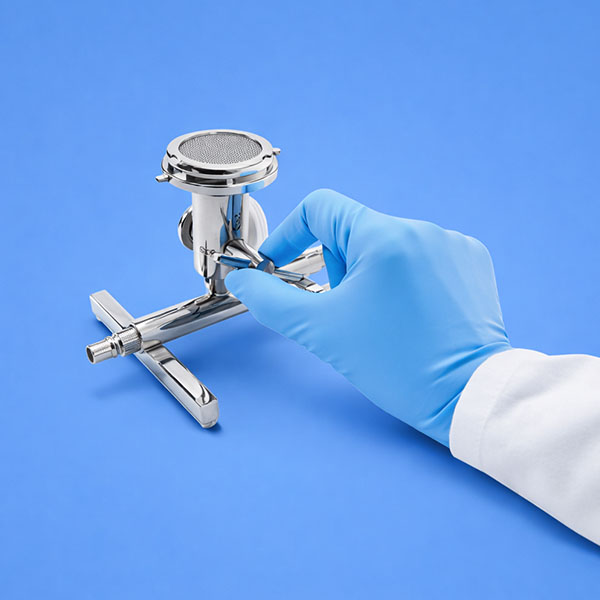
Manifolds
Pharmaco filtration manifolds for pharmaceutical applications are stainless steel assemblies designed for microbiological testing and membrane filtration applications in pharmaceutical, biotechnology, and cosmetics quality control laboratories. These pharmaceutical filtration manifolds provide a controlled, reliable filtration platform for the detection and quantification of microorganisms in liquid samples, supporting accurate and reproducible testing in regulated environments.
Manifolds are an integral component of the membrane filtration process. Whilst the quality of the membrane filter and culture media directly influences test outcomes, the filtration equipment through which the sample passes plays an equally important role in ensuring consistent, contamination-free results. Pharmaco Manifolds are built to meet this requirement, offering a robust and adaptable filtration platform that supports a broad range of microbiological testing procedures across varying laboratory scales and sample volumes.
Designed for durability, ease of sterilisation, and uniform flow control, these membrane filtration manifolds enable efficient multi-sample processing while maintaining compliance with GMP and quality control standards.
Related products
Frequently Asked Questions
A filter manifold is a multi-position vacuum filtration apparatus connecting multiple filter funnels to a single vacuum source, enabling simultaneous filtration of several samples. In pharmaceutical labs, manifolds are used for high-throughput bioburden testing, environmental monitoring membrane filtration, water quality analysis, and sterility test sample processing — reducing total testing time significantly.
Pharmaceutical filter manifolds are available in 1, 3, 6, and 12-position configurations. Each position has an independent valve for individual control of each filtration station — allowing simultaneous processing of multiple samples at different stages, or selective activation of individual positions, without affecting adjacent stations during the filtration run.
Pharmaceutical filter manifolds are available in SS316L stainless steel (GMP-grade, autoclavable, corrosion-resistant — the preferred choice for regulated microbiology labs), borosilicate glass (chemically inert, transparent for visual monitoring of filtration), and polycarbonate or polypropylene with PTFE valves for general laboratory and lower-cost environmental monitoring applications.
Filter manifolds are used in pharmaceutical microbiology for simultaneous bioburden membrane filtration, environmental monitoring sample processing, pharmaceutical water quality testing (USP <1231>), sterility test sample preparation, and container-closure integrity rinse water analysis — all requiring parallel filtration of multiple samples under consistent, documented conditions per GMP requirements.
SS316L filter manifolds are sterilised by autoclaving at 121°C for 15–20 minutes with membrane filter funnels assembled in position. After sterilisation, the assembled unit is transferred to a biosafety cabinet or laminar airflow workstation for use. GMP-grade manifolds may also support steam-in-place (SIP) for direct integration into cleanroom microbiology testing workflows.
Pharmaceutical filter manifolds operate at 200–500 mbar below atmospheric pressure. Excessive vacuum can damage membrane filters, cause sample splashing, or degas aqueous solutions — reducing microbial recovery in bioburden testing. Vacuum must be controlled and consistent across all positions to ensure uniform, comparable filtration results from simultaneous samples.
Standard pharmaceutical filter manifolds accept 47 mm diameter membrane filter funnels — the standard for microbiological membrane filtration with 200–300 mL funnel capacity. Some manifold systems also accommodate 25 mm funnels for smaller sample volumes. Funnels are available in glass (reusable) or pre-sterilised disposable plastic formats for different throughput requirements.
GMP filter manifolds require IQ/OQ qualification confirming valve function and vacuum performance consistency. Autoclave cycle validation, cleaning procedure validation, and periodic preventive maintenance records are required. Equipment logbooks documenting each sterilisation run must be maintained — all records available for regulatory inspection per EU GMP Chapter 6 and 21 CFR Part 211.
Yes, all our products are designed and sourced to meet international regulatory standards, including GMP, USFDA, EU-GMP, WHO, and other relevant compliance requirements.
Absolutely. Our solutions are engineered for seamless integration with existing systems, ensuring minimal disruption and optimal performance within your current setup.
Yes, our team offers technical consultation to help you choose the most suitable product based on your process requirements, facility design, and compliance needs.
Yes, all our products are aligned with our turnkey execution approach, ensuring compatibility with overall facility design, engineering, and operational requirements.
Yes, we provide customised solutions tailored to your process, capacity, and regulatory requirements to ensure optimal performance and efficiency.
Our products are used across pharmaceutical manufacturing, biotechnology, nutraceuticals, research laboratories, and regulated healthcare environments.
We follow strict quality standards and work with trusted technologies and manufacturing processes to ensure consistent performance, durability, and compliance.
Yes, we offer ongoing technical support to ensure smooth operation, performance optimisation, and long-term reliability of all supplied systems and components.